
Dr. Weil Loses His Way
November 20, 2012
Dr. Andrew Weil’s latest book tour stopped in San Francisco last week. He’s on the road to promote his latest literary effort, a cookbook – True Food – based on recipes he cooks at home and are served in his emerging restaurant chain.
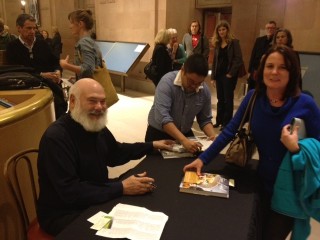
Dr. Weil and a fan at his recent lecture and book signing event in San Francisco.
As part of his Weil Lifestyle campaign the book purports to establish a new healthy lifestyle and healthier recipes while rebutting the myth that ‘health food’ has to be bland or worse.
Dr. Weil was interviewed at Herbst Theater by fellow cookbook author Molly Katzen who spent an hour fawning of the integrative health guru while leaving it to the audience to ask controversial questions. Dr. Weil’s book offers recipes based on his own food pyramid which, while different from the hated FDA guide, leaves out very few foods that have led to the United States obesity epidemic.
In fact , Dr. Weil probably is a pretty good representative of the US population since he clearly doesn’t skimp on any meals. A doctor approaching obesity levels may not be the best spokesman for a healthy lifestyle.
Dr. Weil said he was also scouting sites for a new restaurant – one featuring good healthfood similar to the locations in Los Angeles, San Diego and Phoenix. The fact that the Bay Area has been a leader in the trend Dr. Weil promotes doesn’t seem to rate a mention even though places such as Cafe Gratitude, Planet Organic or Gather are way ahead of the good doctor.
Dr. Weil was asked about supplements and admitted that, aside from a daily multi-vitamin, most folks can get all the nutrition they need from a healthy diet. This does seem to question the range of supplements marketed and sold by Dr. Weil on his own website.
Dr. Weil also took a minute to chastise the assembled group for the failure of Proposition 37 the GMO labeling question of the November ballot. “How you could let that fail?” has asked.
No one rose to answer, but I would note there were several folks in the room who had worked very hard to get the proposal on the ballot and promote it’s passage. No doubt a few of them were a bit insulted that someone from Arizona, who did nothing to oppose the $50 million ad campaign put on by the Monsanto and Dow, would criticize their efforts.
Dr. Weil clearly does not oppose GMO food, preferring to wait for more evidence before branding it unhealthy. Of course, some folks would rather that it get proven healthy before allowing it in the food chain.
I’m afraid Dr. Weil has lost his way by promoting a food pyramid that would do little to improve the health of most Americans, selling suplements that he admits are mostly unnecessary and declining to oppose foods that have been shown to be unhealthy.
I’m sure it will do little to hurt his image or his income.

We Are All Dishonest
October 30, 2012
I just finished Dan Ariely’s book on honesty – “The (Honest) Truth About Dishonesty,” – and while I admit that it could make you feel a bit uncomfortable about trusting anyone, it may be an exercise in proving the obvious.
Ariely is among a group of behavioral economists who try to prove, or disprove, theories based on scientific experimentation. The combination does not always produce the kind of clear conclusions you might like, but his writing is entertaining, comprehensible and always interesting.
Basically he concludes that everyone is corruptable given the right circumstances. The trick is to keep the circumstances to a minimum and take precautions. But then, anyone who has ever filled out a tax return, probably knows that.
My favorite section includes his admonition on the slippery slope that even small rationalizations can create. His insights involving politicians, or CEO’s who claim that they are not influenced by small ‘inconsequential’ lapses in moral standards, is particularly revealing. His observation is best summed up by Queen Gertrude in Hamlet, “Methinks the lady doth protest too much.” A free lunch from a lobbyist may be minor, but it’s probably just the tip of the iceberg.
I do have a couple of reservations about Ariely’s methodology. First, it is largely based on experiments with college students and even he tacitly admits this group may not be representative of the general population.
Second, you have to accept some of his underlying assumptions about what drives human behavior, to trust his conclusions. For example, in discussing medical treatment and evaluating whether true need or profitability is the true driver, he cites dentists who recommend more expensive enamel fillings when less-expensive mercury will do. That enamel is the more expensive option proves the dentist are motivated by greed, Areily claims, since they recommend that option more frequently than mercury.
He may be right, but I think he uses a bad example, because there is more to the enamel vs. mercury debate than just appearance. There is also a safety issue.
But, all in all, it certainly is worth taking a look at Ariely’s work, so you will understand why you, and everyone else, can’t help being dishonest.
What’s Going On in Your Brain
September 21, 2012
I finished more books on the brain over the last few weeks. Actually I finished three, but my friends tell me one doesn’t count. You can decide for yourself.
I won’t pretend to give them all thorough reviews, but I will make a brief comment on each. I think they are all worth reading of you want some insight into what’s going on in your mind as you wander through life.
Charles Duhigg’s “The Power of Habit,” was interesting for the first 125 pages (out of 290). He does a great job explaining how habits develop, but he leaves the specifics about what to do about it until the appendix. He offers a general theory and solution but he stops just short of a full answer. He uses his own habit as an example of how to break a habit. For my money that’s why people buy the book. A good part of the rest of the book was really marketing advice, and while it was interesting, I’m not sure it was ‘on point,’ as they say.
Lawrence Rosenblum’s “See What I’m Saying,” is a great look at neuroplasticity – the brain’s capacity to expand the functionality in one area, to make up for deficits in others. Rosenblum is a psychologist and researcher, not a writer, so his style is exactly the opposite of Duhigg. Where Duhigg is light and easy to read, Rosenblum can be a bit more theoritical or professorial. There’s nothing wrong with it, but you have to work much harder to find the nuggets. But his explanation of how hearing makes up for lost eyesight, or how touch and taste and smell can evolve, to help out when other senses are lost is fascinating.
I also recently read Jonah Lehrer’s “Imagine,” and while I don’t condone his creative quotes from Bob Dylan, he does make some interesting points about the creative process. A good friend of mine told me , “you can never know what he’s making up.” Which is is quite valid – particularly for a journalist.  Maybe I’m just reflecting my own cognitive dissonance -believing what I want to believe – but I don’t think anyone could conjure all the situations and theories he presents out of nothing. In that vein, I’ve decided not to ask Amazon for my money back, even though they offered.
Shuttle Comes to the Bay Area
Endeavour, on its way to Los Angeles, made a few trips around the Bay Area. One was just about over our home. I don’t think any other explanation is needed.





NFL PR Machine
August 30, 2012
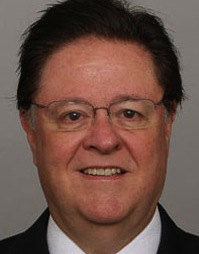
I’m sure John York, Co-chairman of the San Francisco 49ers did not see his
John York, 49ers CEO
presentation last night at the Commonwealth Club, as part of an NFL public relations roadshow, but that’s what it was.
Dr. York, who appeared with former NFL star Dan Fouts and San Diego trauma surgeon A. Brent Eastman, M.D. , was on hand to address traumatic injuries in the NFL. As head of the league’s Health and Safety Advisory Committee, his job was apparently to convince the crowd on hand that for the last 30 years the league has only had the best interests of its players in mind.
While this flies in the face of reality, particularly since over 2,000 former players are currently suing the league to seek compensation for their injuries, Dr. York insisted that the well being of the players has always been the highest priority.
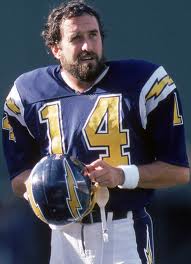
Fouts was on hand to lend support with his litany of injuries, from pulled muscles
Dan Fouts, NFL quarterback
to a broken foot, back, shoulder and hand, many of which were blamed on late hits, which would not have been tolerated in today’s game. The real question might be, why were they tolerated then – when Fouts led the SanDiego Chargers in the 1980’s.
The Hall of Fame quarterback described his injuries in great detail, naming ‘assailants’ in most cases, but expressed clear disdain for the new rules implying that what current 49er quarterback Alex Smith plays is not really football anymore. Presumably because he has only missed two seasons to injuries and is still able to walk.
Fouts, along with his friend and surgeon, Dr. Eastman seemed to contradict himself, when he supported Dr. York’s contention that the game was better off with the new rules.
York denied there was any pressure on team doctors to get players back into the game quickly, saying he knew that was the policy on the 49ers, although he could not vouch for the rest of the league. Fouts told stories of being pushed back into action despite injury, which York claimed would never happen today.
It’s not a question of a team owner calling the team doctor to apply pressure, the doctor does it on his own, beacause he knows who signs his paycheck.
This is particularly true with head injuries and concussions. These injuries have only been addressed in the last few years when the NFL finally stopped relying on a discredited medical expert who claimed that head injuries and long term brain damage were not related. Dr. York says the issue is now being researched – most likely to buttress the League’s court defense .
The panelists may have convinced themselves but I remain skeptical, particularly since the NFL has been forced to make changes by lawsuits and owners who saw major hits to their bottom line when marquee players were out with season-ending injuries.
So You’re a Writer
August 24, 2012
If you are really interested in becoming a writer, take a look at this list and pay attention.
That’s it, no further explanation is necessary.
My Father’s Day
June 14, 2012
This weekend’s holiday will have a bit more meaning for me. It will be my first without Dad.

But I thought I’d post a few memories.
Happiness is Everywhere
April 5, 2012
Suddenly, it seems that we are consumed with the search for one of our ‘inalienable rights.’ It’s not that Americans just rediscovered the Declaration of Independence, or Will Smith’s 2006 movie, but rather, it seems to be the latest social science trend.
Consider it the replacement for behavioral economics the science that became popular after the book Freakonomics tried to explain how economics could explain human behavior. For a few years there was a new book out every month explaining why humans are irrational and how we could be led to do anything with the right incentive.
Now, it seems that happiness, and the apparently futile search for it, has reached the top of the grad student research list. Last month Harvard Business Review (subscription required) focused a whole issue on employee happiness; two weeks ago I received a brochure advertising a full day seminar offered in 8 convenient locations guaranteed to provide me with “effective ways to measure happiness.”
Daniel Gilbert’s “Stumbling on Happiness,” a 2006 best seller may have sparked the recent interest. Gilbert’s book is a well-written and very interesting explanation of how humans define happiness, what it is or is not, and a slightly depressing conclusion that the human mind may never allow us to truly understand what will make us happy. He offers some solace that, at least now that we understand how the human mind works, we will know why we can never find happiness.
Interestingly the writing style and reasoning of the book is quite similar to many of the behavioral economics books, such as “Nudge” or Dan Ariely’s “Predictably Irrational.”
Andrew Weil’s “Spontaneous Happiness,” takes a different approach, offering suggestions for helping us find happiness. His is a less scientific approach and is more a lengthy essay on his own observations about happiness. He offers a number of suggestions of helpful methods to help his readers achieve a state of happiness.
If you are familiar with Dr. Weil’s work you will not be surprised that his suggestions run range from yoga and mindfulness meditation to more secular pursuits such as social activities or laughter. He even offers an ‘8-week Program for Optimal Well Being.”
Dan Buettner, author of “Blue Zones’ which explores circumstances surrounding the lives of the world’s oldest citizens has offered “Thrive – Finding Happiness the Blue Zones Way.” He investigates (and I use that term very loosely) the places around the planet judged to include the happiest populations according to annual surveys.
With apologies to Walt Disney, among the happiest places on earth appear to be parts of Mexico, Denmark, Singapore and San Luis Obispo, California. Even Buettner doesn’t seem to believe that any place in Mexico could be judged happy given the violence, but he doesn’t let that stop him from interviewing the population in an attempt to compile a list of factors that will lead to happiness.
After his trips, Buettner develops a list of “Finding Ways to Thrive” which includes items such as ‘put friends first,’ ‘grow a garden’ or ‘get into teaching.’ While many of his suggestions are valid, and some may apply to a lot of readers, his list is so long and tries to be so inclusive that it’s almost useless in trying to help anyone find happiness.
I have no idea what the answer is. Even Gilbert notes that happiness may be impossible to measure because we all use a different scale. A good friend of mine once suggested that unhappiness is caused by expectations not meeting reality. Maybe the answer lies in taking a more honest look at assessing what your own reality is. And that’s something a coach can help you figure out.
Business is Booming in the President’s Home State
March 15, 2012
Just got back from my morning walk , while on vacation on the Big Island, so I thought I’d pen a few random thoughts.
Traveling on United Airlines was never a great experience, but now that Continental has taken over, it’s worse. San Jose Mercury News had a nice story on the problem this week. People affected most are veteran travelers who use miles and upgrades. Not a good segment to anger since they make up most of your profits.
For my wife and I, it meant an unnecessarily late departure since gate agents had to come on to plane to sort out upgrades to First Class. Took an extra 30 minutes because the computers couldn’t deal with it. We flew coach because they only had one seat to offer. In the past we have been upgraded with no problem.
Otherwise flight was fine – no bumps. Had a nice long chat with flight attendants about what’s going on. They are not happy. But they gave us champagne because they knew we were upset about the seating issues.
Business on the island seems to be really picking up. Mauna Lani and Orchid Hotels seem very busy. Only new business at The Shoppes is a taco stand. Juice 101, where my wife gets her smoothies etc, was booming as was grocery store, as usual.
Spoke to one local dive shop who said it’s best business has been, in three years.
Rental agents say some units are at 95% occupancy over first three months of the year. Although they are hesitant to predict summer they are optimistic. They are even considering raising rates. Tourism is up some from Japan. JAL cancelled direct flights to Kona last year, but there are three charters coming this month. Louis Vuitton at Kings Shops is happy since it’s usually their first stop. Yen is dropping, so we’ll see.

On tour at Hawaiian Vanilla Company. The owner's son explains to visitors how the orchids are grown.
Real Estate folks say the market is improving significantly. One long-term renter I spoke to said she was having trouble finding a place for next year, since so many owners were able to rent short term for more money, or were trying to sell.
Whales seem to be only mammals staying away. Saw a few this morning, but until today, they were few and far between. Locals don’t have an explanation.
Trip to Hawaiian Vanilla Company was worth the drive to the Hilo side. Tour, which included lunch, was given by 18-year-old son of the owner, very poised. He knows his vanilla beans.Coincidentally our friends, Mike and Sallie, who live here, happened to mention the night before that they want to visit Madagascar – which is the world’s largest vanilla producer. Mexico is second.
Trade winds were pretty strong on the first two days, making the golf courses a real challenge, but they have let up a bit today. Went to the farmer’s market Tuesday. Bought bread so I’ll probably be gaining weight, despite the fact that I’ve been running on my walk.
No snow on Mauna Kea, but rain has been good this year and island residents are happy the drought has lessened at bit. Of course no, Hawaiian post would be complete without a gas price update. Yes, regular gas is approaching $5.00 per gallon. Rent a bike.
A Good Read
February 19, 2012
There are all kinds of book reviews. Those that wax poetic about sentence structure and pacing and the finer points of writing, without giving you any indication what a book is about.
Then there are those who tell you the whole story and never tell you if the book is worth buying.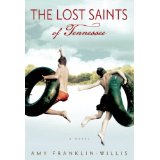
For me, book reviews should be short and to the point.
If you are looking for a good read, pick up a copy of the “The Lost Saints of Tennessee” by Amy Franklin-Willis. – a debut novel in the best Southern literature tradition.
The genre is really beside the point. I don’t really read a lot of fiction and I’m not from the South, but I can honestly say, when I got to the last page, I didn’t want the story to end. To me that’s the mark of fine writing.
It’s good to know Ms Franklin-Willis is already working on the sequel.