
Is it Richard Sherman’s Fault?
January 30, 2014
It’s probably unfair to blame Richard Sherman for Jeannie’s death, but I do.
Sherman is the Seattle Seahawk’s player who tipped a game-winning pass away from The Forty-Niner’s Michael Crabtree in the final minute on the division championship game.
But shortly after that play, Jeannie made good on her year’s-old threat and committed suicide in a lonely extended stay motel just north of San Francisco.
As Sherman was exploding with a steroid induced rant against Crabtree, for a perceived insult months earlier, Jeannie was carrying out a plan she had conceived years earlier. After enduring more than 10 years of worsening depression, she felt she could not endure her own emotional roller coaster any longer.
A San Francisco native, and lifelong ‘Niners’ fan, she no doubt, watched the game, alone, as she arranged her jewelry, attaching notes to the new owners. She had traveled to the Bay Area from her home in Idaho, seeking yet another round of treatment for her affliction.
Maybe it’s not Sherman’s fault. We all share some blame. After all, I watched the end of the game at a friend’s home, less than 5 miles away from her, rooting against the ‘Niners’. As a California transplant, I just could not cheer for a team filled with what I considered a collection of boorish thugs. I’ll leave it to quantum physics to explain, but as the ad says, “It’s not crazy if it works.”
Perhaps, her friends and family should have tried harder to talk her out of her plan. But she made sure no one knew exactly what she was up to. In one of her manic moods, she went shopping a few days earlier, buying expensive new clothes and paying in advance for the alterations.
She kept an appointment with her doctor, listening intently as he explained his new treatment plan. From all accounts she was involved, although unquestioning in her resolve that this time it would work. After all, she had some periods of normalcy, even happiness, just a few weeks ago. We exchanged New Year’s greetings and she was absolutely ebullient that she had turned the corner and 2014 was going to be great.
But, like so many times in the past, it was a false hope, before her last fight from Idaho. She asked that we all respect her privacy as she dealt with the doctor and her inner demons, but that was pretty much the same routine as her previous visits. Hours before we received the call from her husband, still in Idaho, my wife and I had talked about Jeannie and considered, calling, texting, or emailing, deciding that like so many other times, she would let us know when she wanted companionship.
As we left out friend’s home, late Sunday night, we didn’t realize she would be ‘celebrating’ Richard Sherman’s athleticism by signing the papers leaving various body parts to science, particularly her brain, which is now slated for study at Harvard.
I hope it provides some help to another tortured soul. Maybe it will provide some clue of the lasting impact of electric shock treatment, or the permanent changes caused by continual cocktails of prescription medication, cooked up by pharmaceutical companies.
My wife is understandably devastated that her lifelong friend would not even consider some of the complementary techniques that others have found helpful. As best buddies from high school, their lives were intermingled: schools, graduations, parties, trips, vacations. Now, there is no one she can share those memories with.
I don’t know if Jeannie even bothered to take the new selection of ‘miracle drugs,’ before she packed her bags and wrote a final note with a carefully placed arrow pointing to the bathroom where loved ones could find her body.
Mr. Sherman, it’s not your fault, but I need someone to blame.

New York Commentary
September 24, 2013
I just got back from New York City , and couldn’t help making some observations:
As California contemplates naming its newest bridge after the still very alive Willie Brown, it’s worth noting that two well known bridges in New York have been unsuccessfully named after two well respected deceased politicians.
The Triborough Bridge was renamed in 2008 after Robert Kennedy and the Queensboro, or 59th Street Bridge, was renamed for former Mayor Ed Koch. Maybe it takes more than a few years, but both names are used only derisively by New Yorkers, despite numerous signs. The cabbies are particularly dismissive, noting they expect soon-to-be former Mayor Michael Bloomberg, to pay to have the Brooklyn Bridge named after himself.
Speaking of Brooklyn. You can’t help but notice how the borough has become the center of the universe to many. With Nets shirts and paraphernalia far out outnumbering Knicks jerseys, even in Manhattan. Brooklyn is the trendy place to live, work, start a new business or just hang out. But more than one New Yorker pointed out how difficult it is to drive anywhere in Brooklyn and a few noted that it still has a lot of rough edges with graffiti decorating many buildings, and toni new restaurants in neighborhoods where you really would not want to walk at night. Maybe they’re just jealous…who knows?
We took a walk along the High Line – the west side railway converted to a pedestrian walkway. The best part of the walk is the section that crosses 10th Avenue, which includes stadium seating behind a row of huge windows. It’s like watching a series of big-screen televisions, all playing reality TV, New York style. A favorite place for natives to enjoy lunch.
You can’t help but notice the increase in bikes in New York City. The Citi Bikes program which allows anyone who signs up, to take a bike from one stand and return it to another, seems to be a hit with New Yorkers. We did witness a number of near-injury accidents with pedestrians and cars. It just adds to the element of surprise in navigating the New York streets. Drivers seem to universally hate the new vehicles, I guess until they get out of their car and on to a bike. A similar program is just getting under way in San Francisco.
We had a very nice chat with a cab driver from Senegal, explaining to him the difference between being a cabbie in NYC and SF. A few hills but fewer cabs: pedestrians who walk first and expect you to stop: drivers who are relatively polite: fewer people; smaller city; and a host of other factors. He added that driving inn New York can be stressful but it’s just part of the job.
Cabbies here are like waitresses in LA. They are all on their way to something else. Our driver from Senegal was just waiting to start his own business (undetermined) and a second cabbie was going to community college to get an AA so he could become a police officer, like his sister. They actually give policemen a small replica badge (3 each) to give to family members that says “brother of policeman” or whatever is appropriate. He says it helps with minor infractions, but does nothing if you’re caught speeding. My brother-in-law is a SF cop, we got nada. (Will have to check on it)
Genetically Modified food doesn’t seem to be a big issue in New York. Maybe it’s just because we had an initiative that failed in California, or maybe it’s just my wife who won’t eat GMO food, but no one seems to even notice GMO’s. Even a restaurant specializing in healthy , nutrient rich food, made no mention of GMO’s on the menu, and our waiter, seemed puzzled when we asked.
Finally, no trip would be complete without some comments on flying. Yes, we continue to use United Airlines, hoping against hope that we’ll score a free upgrade, based on my lifetime miles. We returned to SF on a reconfigured 757, which included wifi. I never used it before so for $10 I gave it a try. Worked pretty well, although there’s a bit of a delay in response time for web pages. Plus, I only bought an hour and lost part of my time when we crossed a time zone and my clock updated automatically.
While the flights went well, despite two lousy movies, the trip ended on a sour note, as our luggage took almost an hour to get delivered to the baggage claim area. I wouldn’t mention it except that it happens every time we travel. Retrieving baggage at SFO always takes longer than any other airport. No -one seems to be able to explain why, but it’s been consistent for the 20 years I’ve been traveling out of SFO.
As United Airlines begins a new PR campaign to convince us that it really cares about it’s customers, I wish they would fix the parts that matter to its customers.
Getting Away, Southwest Style
July 16, 2013
By now most of us are pretty bored with stories pointing out bad customer service on airlines. But sometimes they can lead to a valuable management lesson. At least I hope so, and if not I’m sure I’ll feel better anyway.
Recently, I was traveling from Boise, Idaho to Oakland, California on Southwest. Plane was scheduled to leave at 6:50 p.m. and was, of course, the last flight out to the Bay Area that day.
Unexpectedly I arrived early, only to find that the flight was ‘delayed slightly’ according to the agent at the ticket counter. So, 6:50 departure, became 7:05, then 7:30 and then 7:55 and then 8:30. By now it was 6:00 and the gate area was filled with folks waiting for a gate agent to see if their connections would be O.K. One traveler even unsuccessfully called the airport paging service to ask that an agent come down to the gate area.
Around the time we should have been boarding, an agent finally shows up and promptly walks away to use the rest room. O.k, so nature calls, it happens. Of course, when she returns she is inundated with passengers wanting to know what to do about their connections.
Her first act is to get on the PA system and say, “Look, I really don’t know what’s going on, and until I do, I don’t have any answers. These things happen all the time, but the more you people stand up here asking me questions the longer it will take me to sort this out, so please do not come to the desk area.”
Two hundred shocked passengers retreated in fear.
But, here’s my point. Southwest knew the flight was delayed when they sent her to the gate, don’t you think she should have known what was coming and possibly checked out the situation before she got to the desk?
Flight delays may happen to her all the time, but to most of the ticket holders in the waiting area, it was just a bit more stress they didn’t need.
Eventually, it all got sorted out and people were rerouted and booked on flights the next day…and we made it back to the Bay Area 2.5 hours late. But it sure seems like a manager might have suggested she show up prepared, so that she wouldn’t be treating her paying customers like third graders waiting for recess.
Certainly made me an ex-Southwest customer.
Who am I?
June 21, 2013
As many of my twitter followers (@eariess) may know I appear on a weekly radio show in Sonoma, CA. As the newest member of the cast, they (Jim and Rick) decided to investigate the interloper (me) for their listeners.
But I also wrote a short note for the hosts newsletter, which I thought I’d reproduce here. (My nickname is Ace–don’t ask why, it’s a long story):
Jim, Rick,
Thanks for the chance to talk to the good folks of Sonoma.
Of course, on the way home, I thought of all the stuff I should have said:
Who is ace?
I am a husband devoted to the love of my life- the Queen- the world’s first Concierge Wellness Consultant
I am a step-dad to two women, who despite my meddling in 10 years of their life, turned out pretty well.
I am, and will forever be, a journalist, newsman and writer, even if I never write the great American novel.
I am a coach who takes pride in helping my clients find the path they want.
I am a photographer, although digital imaging, as it’s called today, will never have the same ring.
I am a gardener, who takes pride in my 100 roses, and the beauty I try to bring to the world.
I am my father’s son, and hope that they have a radio up where he is, so he can listen to me and my good friends entertain a small corner of California.
Thanks,
Ace
You can download the podcast to the show –part 1, the first hour or part 2 ,the second hour.
BTW: The weekly newsletter is worth reading, so if you want to receive it on a regular basis, write to Thisweekinsonoma@aol.com just note that Ace suggested you sign up.
So, Why Does the World Exist?
May 10, 2013
I admit that I started reading Jim Holt’s “Why Does the World Exist?” as penance. Many years ago, Douglas Sturm, my political theory seminar leader at Bucknell University, tried to introduce me to Plato.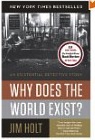
Seems I never had time for the deep thinking required and I almost flunked.
So when I saw Mr. Holt’s book on several 10-best lists last year, I decided to get it another try, for Professor Sturm.
I guess it took 43 years before my brain could wrap itself around the concepts but I’m glad Mr. Holt succeeded.
I would recommend this book for anyone who wants to spend some time contemplating our world’s oldest question, but particularly journalists who get caught up in the daily routine of facts, figures and political hyperbole.
Holt’s writing is erudite, easy to read and understand but filled with concepts that most of us never consider, or try to avoid.
At the same time, like any good journalist, he examines the question posed in his title from every conceivable angle. No just as a personal essay, but by interviewing leaders in the field and then explaining what they seem to be saying.
Others have called his book a “detective story” but, like his readers, who want concrete answers, he accepts or rejects various arguments along the way. He reaches his own conclusions, which we are free to accept, or not, and manages to humanize the whole effort with references to his own life and his experience with death.
The journey is interesting, entertaining and, if Professor Sturm is reading this, enlightening. I’m finally starting to understand some of what Plato was telling us. Thanks for whetting my appetite.
Manhunt Management Decisions
April 19, 2013
You wouldn’t think the on-going manhunt in Boston would lead to bad management decisions, but it does. Many of the firms in the Boston suburbs have employees who live in the affected areas. This leads to a decision about whether or not to open.
One Lexington company put out the following statement:
“In light of the current public safety issue arising from the search for the second suspect, please your discretion as to whether you come into work or work from home. There are no warnings about Lexington specifically, but several neighboring communities have been urged to stay indoors and close their businesses. … will remain open today but please do what you feel comfortable with.”
This is a cop-out of the highest order. (excuse the pun) Employees should not even have to make the decision. The company, if it’s really worried about the safety of employees, should just close up for the day.
Why force your employees to make a tough decision and worry about whether they will be docked for a day’s pay. Why create an artificial division between those who ‘made it in’ and those who felt better staying home – whether they were in the affected area or not.
This is just bad management from a firm which seems more concerned with it’s own liability than its employees.
Boston You’re My Home
April 16, 2013
I’ve lived in the Bay Area for 18 years, but Boston will always be my home town. I was in San Francisco during 9/11 and while I had visited New York often, I had only been to the World Trade Center once. I grieved for the loss of life but it was still an event that happened to strangers.
But I’ve walked down Boylston Street in the rain, the snow, and on a crisp Spring day like yesterday. I’ve watched the beginning of the Boston Marathon in Hopkinton and the end, just yards away from yesterday’s explosion.
I know who Bill Rodgers is, why John Kelley-the elder – is a Boston legend, and who first suspected Rosie Ruiz was a fraud. I’ve waited in the lobby of the Lenox Hotel -before it was remodeled and became respectable.
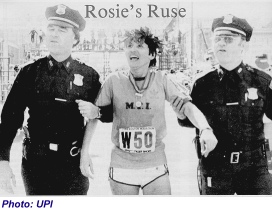
Rosie Ruiz, almost a winner
I know that the area is called Back Bay, because it used to be a bay until our colonial forefathers decided they needed more land for their cows to graze. And yes, until recently, I loved that dirty water, because Boston was my home.
I’ve been to the Patriots Day game at Fenway Park and walked down to the see the finish of the race, and then walked back to Fenway for the second half of what used to be a day-night doubleheader.
I can tell you the name of every store, bar, restaurant, gallery or hair salon that you pass walking from Boston Public Garden to Mass Ave. I can remember my mother teaching me the names of the cross streets to help me learn the alphabet-Arlington, Berkeley, Clarendon, Dartmouth, Exeter, Fairfield, Gloucester and Hereford.
I know where Dorchester is and the neighborhood where 8-year-old Martin Richard lived and I’ve been to Revere where police searched an apartment for clues.
I’m happy when the A’s , Giants, or 49ers , or Warriors do well, but I FOLLOW the Bruins, Celtics, Patriots and Red Sox. I’m sorry, but it’s part of me.
I guess that’s why yesterday’s events have a much greater impact. The Marathon will no longer be the great fun-loving, 26-mile event that it once was. Security will be tighter, everyone will be on edge. Parents won’t let their kids take the T into town to watch the end of the race and Sox fans will think twice about walking to Copley Square to see friends cross the finish line.
I know the city will recover. New York has recovered – mostly. But, when I visit Boston later this year and walk down Boylston Street once more it won’t be the same, and that’s what really pisses me off.
A Real Love Story
February 14, 2013
I’ve been reading all the “most romantic” movie lists. Some are good, many leave me wondering how some folks even define love.
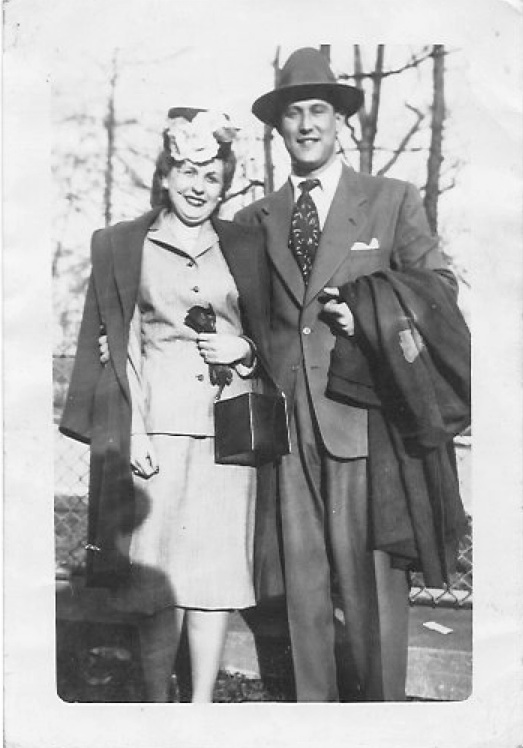
Mom and Dad 1946
My most romantic ‘movie?’
Easy. My Mom and Dad, married 62 years, in love every day from the first time they saw each other. He survived three wounds in WWII while she unknowingly waited for him back home.
Never saw them argue, because Dad knew the two most important words were always, “Yes Dear.” Only disagreement they ever had, they claim, was early in the marriage, when they did argue and dad stormed into the bedroom to pack: Only to emerge 10 minutes later asking if mom would help him fold his shirts.
If that’s not romance, I don’t know what is.
A Good Book Undone
December 24, 2012
Politics has undermined a look of good things in this country recently, but I never thought I’d accuse it of ruining a perfectly good book.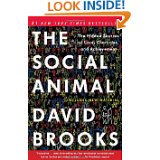
I guess it’s not the politics, but rather author David Brooks, who I should blame for my disappointment in his exploration of what he calls our ‘revolution in consciousness.’
Brooks attempts to meld fiction and science by explaining advances in neuroscience, genetics, psychology, sociology and economics through the real lives of two fictional characters. He follows them from conception to death explaining to us what’s really going on both consciously and sub-consciously.
Anyone who has read the current literature on neuro-psychology, behavioral economics or social theory will be familiar with the concepts, but Brooks does a nice job of translating the theories into real life.
Brooks, who is a New York Times columnist, write in a clear and linear style like may journalists, and his work is both believable and entertaining.
His biggest problem is his detour into politics. While Brooks is known for his conservative views, they are not the problem. My issue is with the method. The female character Brooks creates overcomes a poor childhood to excel in school and career. There is no inkling that she has slightest interest in politics but then suddenly at the height of her corporate career, she is named the head of a national presidential campaign, which lands her a job in the White House. Her husband takes a job in a Washington ‘think tank’ and becomes the mouthpiece for Brook’s views about governing, politics and the American political system.
Just in case you weren’t sure what he was doing, the charcater emphasizes that the only person who agrees with him is an ‘unnamed’ New York Times columnist.
The whole chapter seems contrived and out of place and detracts from the excellent work Brooks does to bring both his characters and scientific theory to life.
Despite this flaw Brooks work is very readable and is an easily understandable look at the science. Especially outstanding is his look at death and dying on the final pages.
So, you can skip chapters 19 and 20 if you don’t want to let politics ruin a good read, but certainly the other 20 chapters are well worth your time.
The Week in Review
December 9, 2012
Jim Levy, AKA Jimmy The Kid, writes a weekly summary of the news based on his radio show in Sonoma, CA.
The column includes links to listen to his show, as well as a great recap (with commentary) of what’s going on in the world.
I’m a semi-regular on the show so I thought I’d start posting his newsletter on my blog so everyone could benefit from his wisdom. If you want to get the newsletter on a regular basis drop him a note at Thisweekinsonoma@aol.com .
Click here to download the newsletter as a PDF file;