
The Wisdom 2.0 Bottom Line
March 2, 2015
I spent the last few days at the annual Wisdom 2.0 conference in San Francisco.
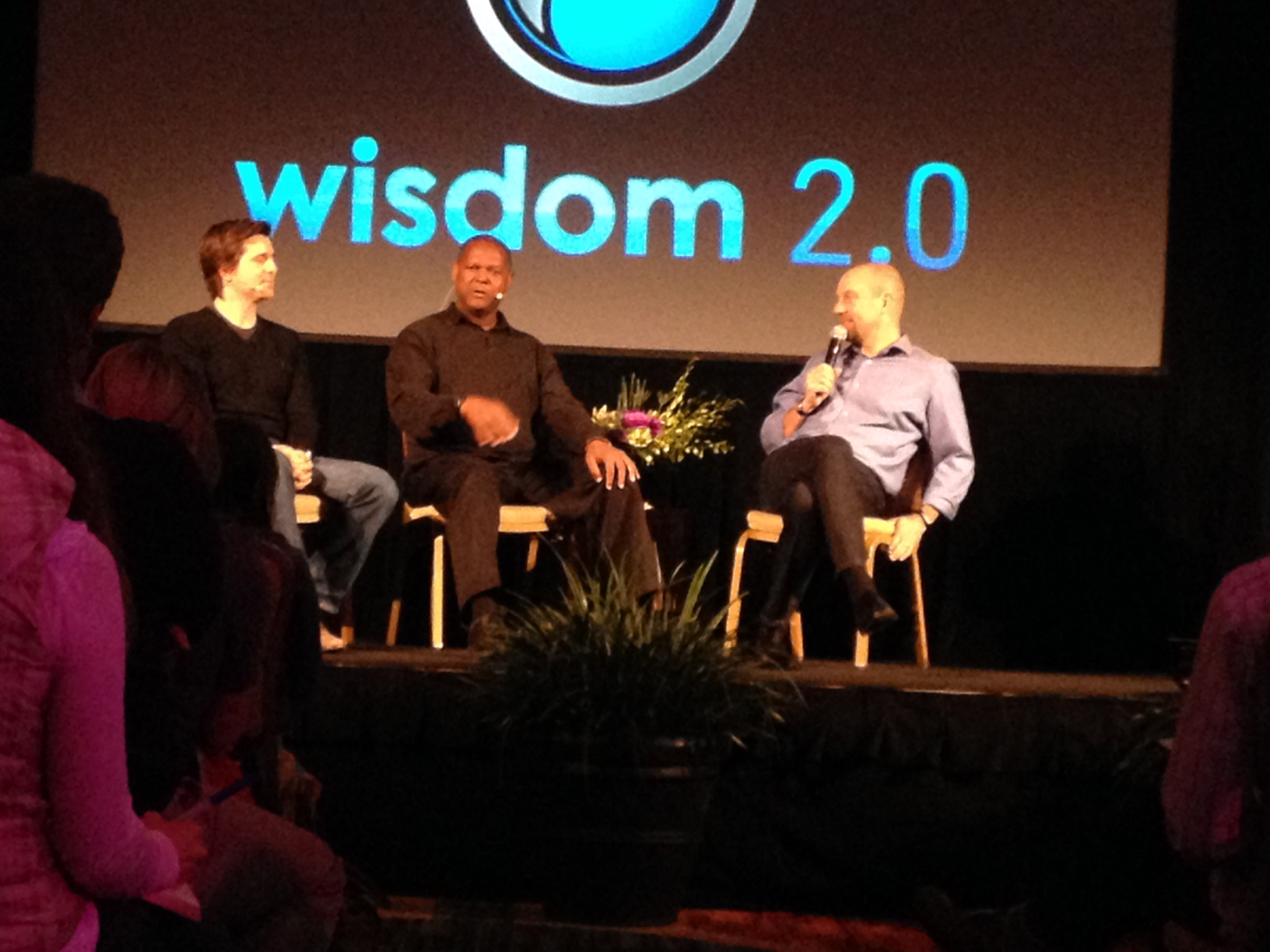
Michael Gervais, (left) George Mumford and Mike Robbins (right) discuss sports and psychology and the Wisdom 2.0 conference in San Francisco February 28, 2015,
Many of you have probably never heard of the event, so a little context is probably in order.
Attendance this year reached 2500 and could have gone higher if organizers had not capped it. The conference is designed as a combination celebration and support group for anyone trying to bring more: (pick one) consciousness, gratitude, or mindfulness to technology and business.
Attendees come from all over the world, although a large percentage are from California, to hear a variety of speakers from CEO’s to human resource managers, explain how they have tried to humanize their companies and deal with the increasing demands of the ‘always on’ world.
Using mindful meditation, exhortations to be present, and a wide variety of what many might consider alternative techniques, the conference is in direct contrast to the prevailing view of corporate America as a ruthless, cut throat, bottom line, profit driven culture.
In addition to the conference presentations on everything from neuroscience to networking, there are rooms devoted to meditation, and yoga, as well as a trade show in the Inspiration Lounge.
Many sessions focus on how to live a more fulfilling and compassionate life and to make choices that leave you happier both personally and in your career.
Here you can also find the latest in relaxation and stress reduction equipment and techniques.
While you might think the principles were some import from Europe, most of the foreign attendees, are quick to note that the techniques are uniquely American, which is what draws them here.
Companies with representative include LinkedIn, Facebook, Twitter, Google, Gap and a host of others who say that recent studies have shown conclusively that promoting mindfulness and self realization in their workforce actually adds to their bottom line in quantifiable manner.
In reality the conference is a large networking event, where like-minded folks can get together to reinforce their beliefs in hopes of connecting with someone who can help them move forward in their career.
A large percentage of the attendees are personal/executive coaches or management consultants, who are looking to make connections with those HR types from Google, Twitter, Facebook and GAP, to improve workplace performance. Admittedly the chances are slim, but you never know.
In two days I collected a raft of business cards, and spoke with lawyers, coaches, HR managers and some old friends from the spa and yoga worlds.
My wife, who is a clinical psychologist, and attended the first Wisdom conference 6 years ago, may be a more typical participant, but she was ill over the weekend and insisted I attend.
I’ll admit I was hesitant, but after three days I was pleasantly surprised and happy I made the effort. More on some of the things I learned will come in subsequent posts.
When organizers at the opening session asked who, in the audience, was a first-time attendee, I raised my hand along with two-thirds of the crowd.
Sponsors were thrilled, saying it showed how the movement was attracting new members. But you have to think; what does it mean when attendees at previous sessions are not coming back in significant numbers?
If this were a business that had to rely on new customers for 66% of it’s profit each year, would you be optimistic?

Thank You, US Postal Service
January 25, 2015
The United States Postal Service gets a lot of grief these days. Derided as the delivery agent for ‘snail mail,’ they are criticized for being too expensive, too slow, outdated and time consuming in the era of instant communication.
I am here to defend them.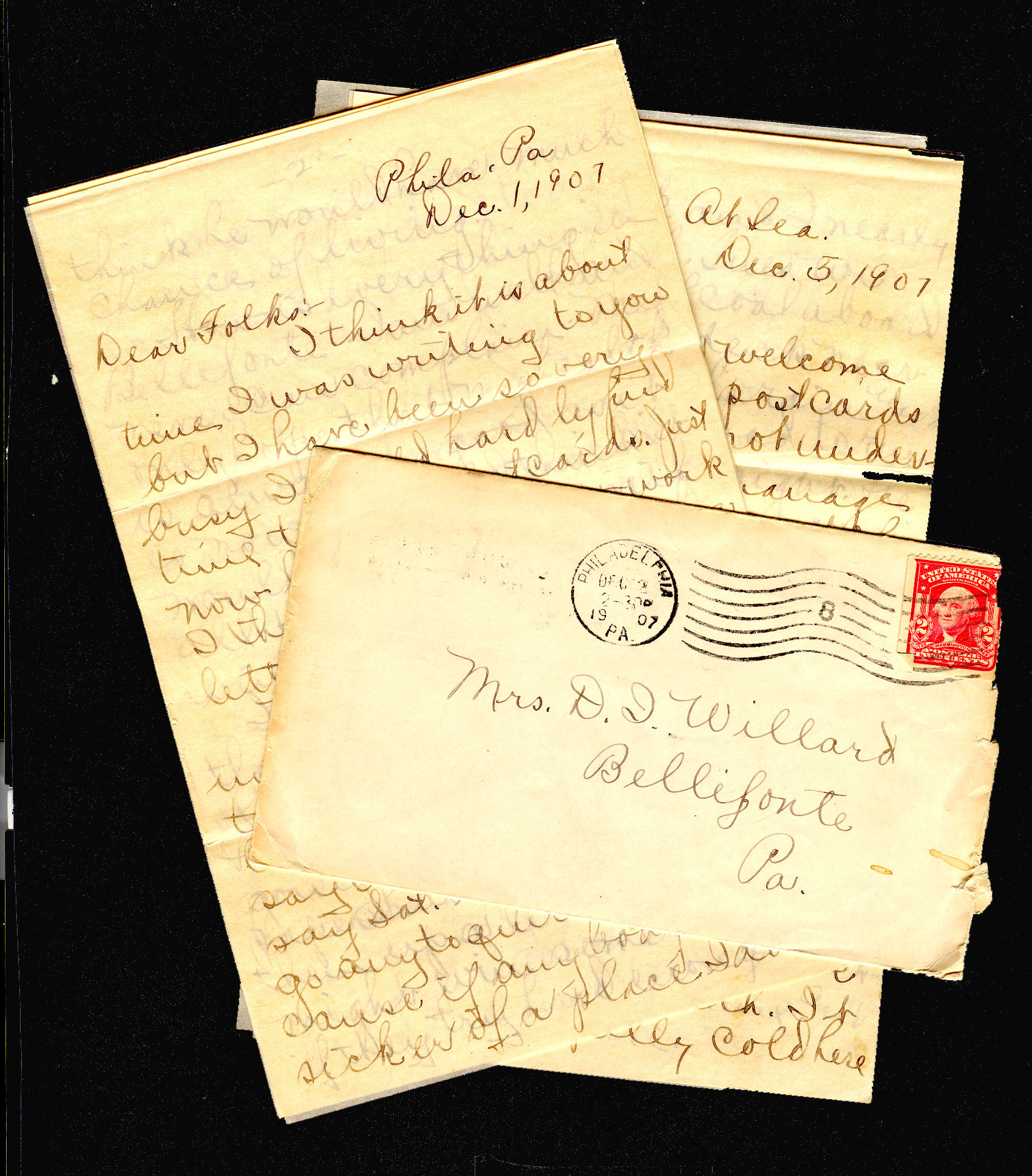
Yes, I have tracked letters sent via ‘Priority Mail’ as they traveled to San Diego before reaching their intended destination 10 days later, two zip codes from my office. I can send a package to Hawaii (from San Francisco) in two days, but the same size box to Boston takes over a week.
And yes, grandma, I remember when a first class stamp was 5 cents. I now buy forever stamps in rolls of 100, so I don’t even know what first class postage is. (Great marketing, if you ask me.)
I can text my friends all over the country and within 10 minutes will have a response…any longer and I get impatient. Email, which we all thought was great a few years ago, is now too slow, since most people still have to check before responding.
I tweet to my followers, and most of my relatives have Facebook pages,so we’ll all know who’s doing what. I write this blog so everyone knows how I feel about what’s going on in the world.
But none of those methods can generate the emotions of a stamped letter. Neuroscientists now know that memories are more than just events. Our brains recall all five senses and any of them can spark a memory.
I was reminded of that this week, when a good friend, David Allen, sent me a batch of letters, found while cleaning out his mother-in-law’s attic.
They were written over 47 years ago when I was a freshman at Bucknell University in Lewisburg, PA. In fact, they were written in the first few months of college, when I was really still attached to my high school experience and scared to death about the future.
I remember the onion paper, the smell of the inked ribbon , and the old green and white Smith Corona that I used, to peck out letters to my parents, friends and former high school classmates. I still have the typewriter in fact – even had it reconditioned after I found it while going through my old homestead when my Dad died. I’m told it’s a collector’s item.
The letters were written to David’s wife, Betty, my best friend, and while we were never involved romantically, are filled with good natured banter that would pass for flirtation.
The actual content is really irrelevant: my observations about classes, social life, campus events, and gossip. It was 1967, and I know every campus was awash in protest and politics, but there’s none of that, so I doubt Oliver Stone will need them for some new 1960’s expose.
But for me, they are more important than any email, tweet or text I will ever send. When I re-read the words, and hold the letters, the memories of those years come flooding back. More importantly, I’m talking to my friend, Betty, again, even though she was struck down by cancer 12 years ago.
So, while I can find endless versions of various web pages, and can see the trail of my texts to friends and colleagues, none of them will ever hold the power of the printed word that I can pick up, hold in my hand, and still smell the memories from so many years ago.
For that I thank the US Postal Service and David, who was thoughtful enough to mail them back to me..
Unconscious Bias
September 24, 2014
A lot has been written over the last year about steps Silicon Valley companies are taking to combat bias in hiring.
In case you missed it, over 70% of the workforce at many firms, is white and male. A recent NYT article details the problem and some proposed solutions.
But I think the issue is closer to most people’s homes than they realize. A recent example helps prove my point.
My ophthalmologist, is the mother of twins , a boy and a girl. I have been seeing her for almost 15 years so I’ve followed the normal trials and tribulations of parenting.
The children are now, at 15, starting to make choices about college and careers. At my last appointment the doctor said the young man had really applied himself and was looking forward to technology/science as a career and was looking at top tech schools.
When I asked about her daughter, the doctor said she found math and science “too hard,” adding,”all my friends just want to get Liberal Arts degrees.” The doctor’s response,”Well, OK, if that’s what you want.”
I was slightly appalled, and my expression must have revealed my thoughts, because she asked, “Do you think I should have pushed her more?”
We had a lengthy discussion, in between eye chart readings. But it made me wonder how many other subtle signals the little girl had received about avoiding math and science.
It’s no surprise the Silicon Valley workforce is overwhelmingly male, if even a professional women, in a field that certainly required some science (ophthalmology), wouldn’t even urge her daughter to consider science and math because they are “too hard.”
Maybe a short visit with an unbiased career counselor/coach would help break through the peer pressure and produce a few more female engineers for the next great startup.
Sun Valley Serenade
September 2, 2014
My wife and I closed another hotel this weekend.
Well, I guess the Sun Valley Lodge was going to shut down for 9-month renovation, whether we stayed or not, but we were among the last guests to see the Lodge in its current incarnation.

The spa and apartment units
The 124-room, 78-year old symbol of high-end fun in the snow will be converted into a 96-room playground for the rich and famous.
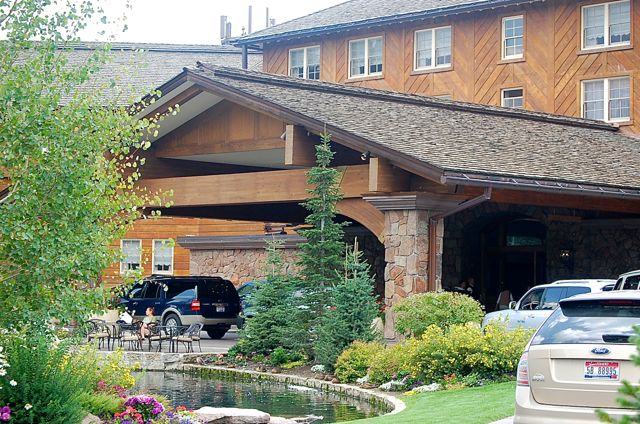
Big changes planned inside
The Lodge will renovate every room, except one, expanding them to accommodate fireplaces, and updated bathrooms which will include Jacuzzi tubs and modern amenities.
The truth is the renovation is long overdue. While the Lodge, which bills itself as America’s first destination ski resort, is the priciest in the Ketchum-Sun Valley area, it fares poorly when compared to many budget priced hotel rooms. Where rooms are larger, and bathroom space for two people often included double sinks.
The Lodge was built in 1935 by the Union Pacific Railroad and has only had three owners. It’s only relatively recently that the current owner Carol Holding, who owned Sinclair Oil with her late husband Earl, made the resort and the surrounding area into a year-round destination.
The Holdings also own a number of other five-star resort properties in the Western United States
Before Mr. Holding, began marketing the location to events such as the annual Allen and Co. technology and media conference, most of the private jets at the Blaine County airport, only came during ski season. Now it’s not unusual to see folks like Arnold Schwarzenegger, Mariel Hemmingway, or tech moguls wandering downtown Ketchum year round.
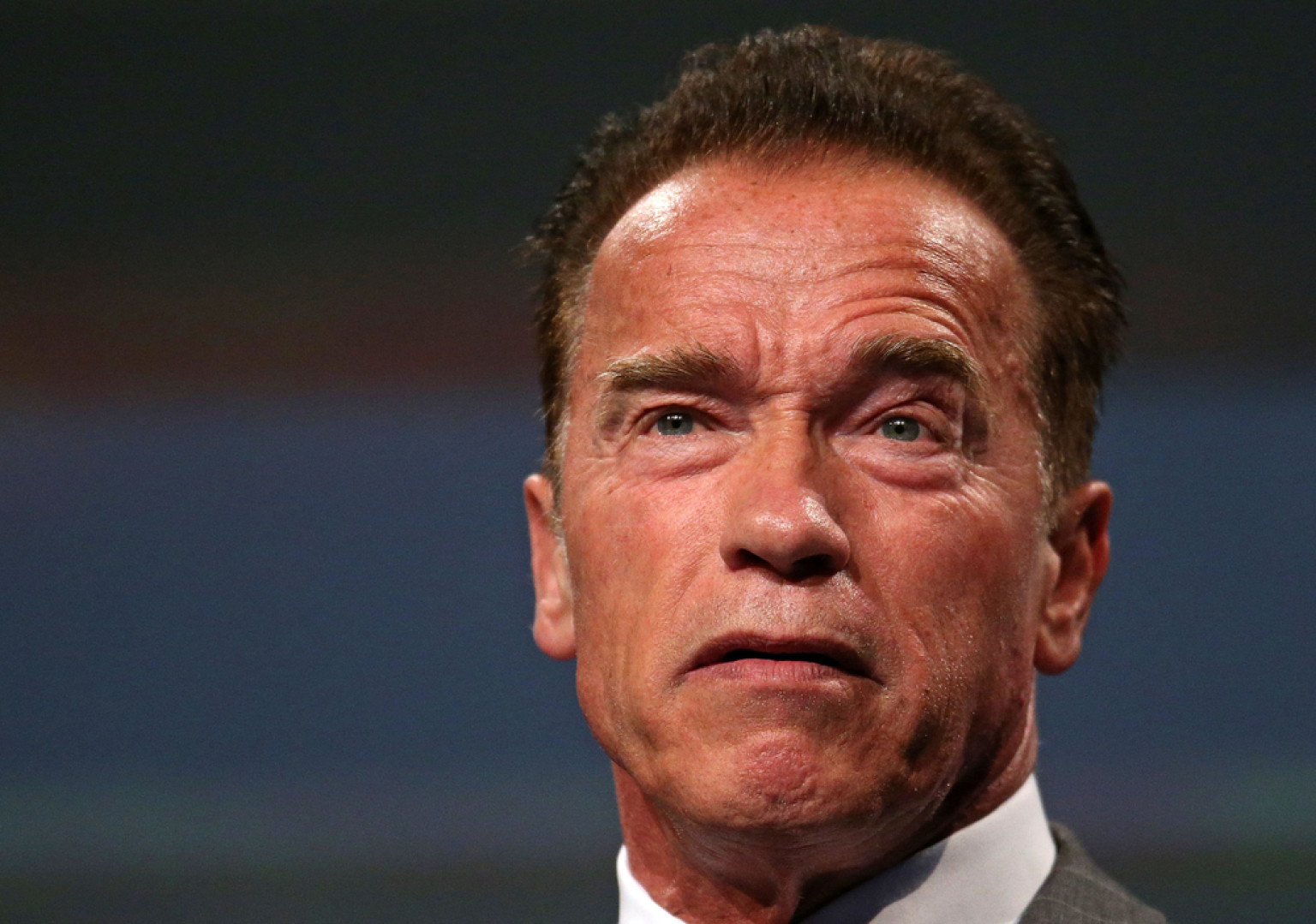
A Labor Day visitor
California’s former governor was there over the recent Labor Day weekend, with his current young honey, but that’s a story for another post.
For the last four months the Lodge has been the site of a major addition to accommodate a new spa and fitness center as well as several 4-bedroom apartment units designed for families or wedding parties.
You can find more details about the renovation at the Lodge website but you won’t be able to stay there until June of 2015 – just in time for the Allen and Company gathering.
A true sign of the year-round nature of the Lodge business, is the fact that they are closing for the what used to be high-season for The Valley ski industry.
Until next summer, you can stay at the Sun Valley Inn, the sister hotel barely 100 yards away, or at any of the many condominiums managed by the Lodge.
In general, locals are thrilled and seem genuinely happy that a new generation of the Holding family is taking an active interest in managing the mini-empire. Carol Holding, is in her 80’s, and has been largely a ceremonial leader since her husband died in 2013 but her son, Stephen, has apparently taken over and as the press release says, wants to guarantee another 75 years of ownership.
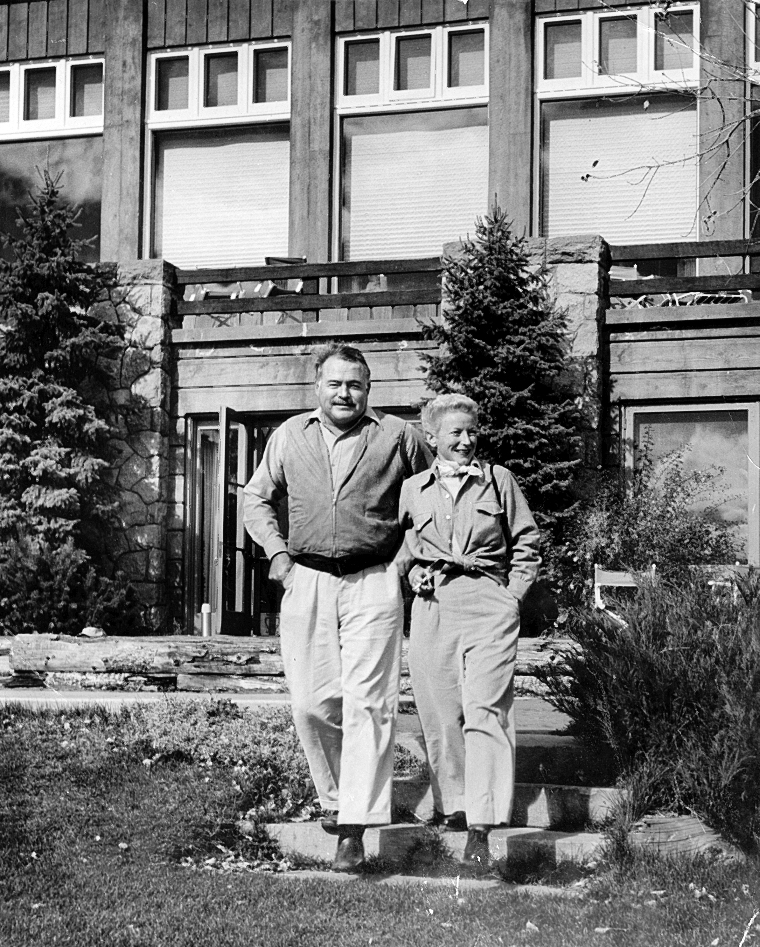
Ernest and Mary Hemingway
By the way, that lone room that will not be renovated? You guessed it – room 206, which hosted Ernest Hemingway and his lover in 1939, as ‘Papa’ finished “For Whom the Bell Tolls.” Current hotel employees say the room has never been fully renovated and includes the original claw-foot tub- and can still be rented – although the plumbing apparently clogs frequently.
But the isolated cabin, where Hemingway lived during his Sun Valley years, and where he died, is on private land and not open to the public.
If my wife and I probably win the lottery by next year- we’ll be able to afford the rates at the new Lodge, since the area is truly a beautiful destination any time of the year and we look forward to returning for the annual Sun Valley Wellness Festival next May.
Getting Away, Southwest Style
July 16, 2013
By now most of us are pretty bored with stories pointing out bad customer service on airlines. But sometimes they can lead to a valuable management lesson. At least I hope so, and if not I’m sure I’ll feel better anyway.
Recently, I was traveling from Boise, Idaho to Oakland, California on Southwest. Plane was scheduled to leave at 6:50 p.m. and was, of course, the last flight out to the Bay Area that day.
Unexpectedly I arrived early, only to find that the flight was ‘delayed slightly’ according to the agent at the ticket counter. So, 6:50 departure, became 7:05, then 7:30 and then 7:55 and then 8:30. By now it was 6:00 and the gate area was filled with folks waiting for a gate agent to see if their connections would be O.K. One traveler even unsuccessfully called the airport paging service to ask that an agent come down to the gate area.
Around the time we should have been boarding, an agent finally shows up and promptly walks away to use the rest room. O.k, so nature calls, it happens. Of course, when she returns she is inundated with passengers wanting to know what to do about their connections.
Her first act is to get on the PA system and say, “Look, I really don’t know what’s going on, and until I do, I don’t have any answers. These things happen all the time, but the more you people stand up here asking me questions the longer it will take me to sort this out, so please do not come to the desk area.”
Two hundred shocked passengers retreated in fear.
But, here’s my point. Southwest knew the flight was delayed when they sent her to the gate, don’t you think she should have known what was coming and possibly checked out the situation before she got to the desk?
Flight delays may happen to her all the time, but to most of the ticket holders in the waiting area, it was just a bit more stress they didn’t need.
Eventually, it all got sorted out and people were rerouted and booked on flights the next day…and we made it back to the Bay Area 2.5 hours late. But it sure seems like a manager might have suggested she show up prepared, so that she wouldn’t be treating her paying customers like third graders waiting for recess.
Certainly made me an ex-Southwest customer.
Who am I?
June 21, 2013
As many of my twitter followers (@eariess) may know I appear on a weekly radio show in Sonoma, CA. As the newest member of the cast, they (Jim and Rick) decided to investigate the interloper (me) for their listeners.
But I also wrote a short note for the hosts newsletter, which I thought I’d reproduce here. (My nickname is Ace–don’t ask why, it’s a long story):
Jim, Rick,
Thanks for the chance to talk to the good folks of Sonoma.
Of course, on the way home, I thought of all the stuff I should have said:
Who is ace?
I am a husband devoted to the love of my life- the Queen- the world’s first Concierge Wellness Consultant
I am a step-dad to two women, who despite my meddling in 10 years of their life, turned out pretty well.
I am, and will forever be, a journalist, newsman and writer, even if I never write the great American novel.
I am a coach who takes pride in helping my clients find the path they want.
I am a photographer, although digital imaging, as it’s called today, will never have the same ring.
I am a gardener, who takes pride in my 100 roses, and the beauty I try to bring to the world.
I am my father’s son, and hope that they have a radio up where he is, so he can listen to me and my good friends entertain a small corner of California.
Thanks,
Ace
You can download the podcast to the show –part 1, the first hour or part 2 ,the second hour.
BTW: The weekly newsletter is worth reading, so if you want to receive it on a regular basis, write to Thisweekinsonoma@aol.com just note that Ace suggested you sign up.
Manhunt Management Decisions
April 19, 2013
You wouldn’t think the on-going manhunt in Boston would lead to bad management decisions, but it does. Many of the firms in the Boston suburbs have employees who live in the affected areas. This leads to a decision about whether or not to open.
One Lexington company put out the following statement:
“In light of the current public safety issue arising from the search for the second suspect, please your discretion as to whether you come into work or work from home. There are no warnings about Lexington specifically, but several neighboring communities have been urged to stay indoors and close their businesses. … will remain open today but please do what you feel comfortable with.”
This is a cop-out of the highest order. (excuse the pun) Employees should not even have to make the decision. The company, if it’s really worried about the safety of employees, should just close up for the day.
Why force your employees to make a tough decision and worry about whether they will be docked for a day’s pay. Why create an artificial division between those who ‘made it in’ and those who felt better staying home – whether they were in the affected area or not.
This is just bad management from a firm which seems more concerned with it’s own liability than its employees.
A Good Book Undone
December 24, 2012
Politics has undermined a look of good things in this country recently, but I never thought I’d accuse it of ruining a perfectly good book.
I guess it’s not the politics, but rather author David Brooks, who I should blame for my disappointment in his exploration of what he calls our ‘revolution in consciousness.’
Brooks attempts to meld fiction and science by explaining advances in neuroscience, genetics, psychology, sociology and economics through the real lives of two fictional characters. He follows them from conception to death explaining to us what’s really going on both consciously and sub-consciously.
Anyone who has read the current literature on neuro-psychology, behavioral economics or social theory will be familiar with the concepts, but Brooks does a nice job of translating the theories into real life.
Brooks, who is a New York Times columnist, write in a clear and linear style like may journalists, and his work is both believable and entertaining.
His biggest problem is his detour into politics. While Brooks is known for his conservative views, they are not the problem. My issue is with the method. The female character Brooks creates overcomes a poor childhood to excel in school and career. There is no inkling that she has slightest interest in politics but then suddenly at the height of her corporate career, she is named the head of a national presidential campaign, which lands her a job in the White House. Her husband takes a job in a Washington ‘think tank’ and becomes the mouthpiece for Brook’s views about governing, politics and the American political system.
Just in case you weren’t sure what he was doing, the charcater emphasizes that the only person who agrees with him is an ‘unnamed’ New York Times columnist.
The whole chapter seems contrived and out of place and detracts from the excellent work Brooks does to bring both his characters and scientific theory to life.
Despite this flaw Brooks work is very readable and is an easily understandable look at the science. Especially outstanding is his look at death and dying on the final pages.
So, you can skip chapters 19 and 20 if you don’t want to let politics ruin a good read, but certainly the other 20 chapters are well worth your time.
Dr. Weil Loses His Way
November 20, 2012
Dr. Andrew Weil’s latest book tour stopped in San Francisco last week. He’s on the road to promote his latest literary effort, a cookbook – True Food – based on recipes he cooks at home and are served in his emerging restaurant chain.
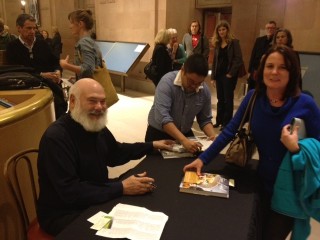
Dr. Weil and a fan at his recent lecture and book signing event in San Francisco.
As part of his Weil Lifestyle campaign the book purports to establish a new healthy lifestyle and healthier recipes while rebutting the myth that ‘health food’ has to be bland or worse.
Dr. Weil was interviewed at Herbst Theater by fellow cookbook author Molly Katzen who spent an hour fawning of the integrative health guru while leaving it to the audience to ask controversial questions. Dr. Weil’s book offers recipes based on his own food pyramid which, while different from the hated FDA guide, leaves out very few foods that have led to the United States obesity epidemic.
In fact , Dr. Weil probably is a pretty good representative of the US population since he clearly doesn’t skimp on any meals. A doctor approaching obesity levels may not be the best spokesman for a healthy lifestyle.
Dr. Weil said he was also scouting sites for a new restaurant – one featuring good healthfood similar to the locations in Los Angeles, San Diego and Phoenix. The fact that the Bay Area has been a leader in the trend Dr. Weil promotes doesn’t seem to rate a mention even though places such as Cafe Gratitude, Planet Organic or Gather are way ahead of the good doctor.
Dr. Weil was asked about supplements and admitted that, aside from a daily multi-vitamin, most folks can get all the nutrition they need from a healthy diet. This does seem to question the range of supplements marketed and sold by Dr. Weil on his own website.
Dr. Weil also took a minute to chastise the assembled group for the failure of Proposition 37 the GMO labeling question of the November ballot. “How you could let that fail?” has asked.
No one rose to answer, but I would note there were several folks in the room who had worked very hard to get the proposal on the ballot and promote it’s passage. No doubt a few of them were a bit insulted that someone from Arizona, who did nothing to oppose the $50 million ad campaign put on by the Monsanto and Dow, would criticize their efforts.
Dr. Weil clearly does not oppose GMO food, preferring to wait for more evidence before branding it unhealthy. Of course, some folks would rather that it get proven healthy before allowing it in the food chain.
I’m afraid Dr. Weil has lost his way by promoting a food pyramid that would do little to improve the health of most Americans, selling suplements that he admits are mostly unnecessary and declining to oppose foods that have been shown to be unhealthy.
I’m sure it will do little to hurt his image or his income.
We Are All Dishonest
October 30, 2012
I just finished Dan Ariely’s book on honesty – “The (Honest) Truth About Dishonesty,” – and while I admit that it could make you feel a bit uncomfortable about trusting anyone, it may be an exercise in proving the obvious.
Ariely is among a group of behavioral economists who try to prove, or disprove, theories based on scientific experimentation. The combination does not always produce the kind of clear conclusions you might like, but his writing is entertaining, comprehensible and always interesting.
Basically he concludes that everyone is corruptable given the right circumstances. The trick is to keep the circumstances to a minimum and take precautions. But then, anyone who has ever filled out a tax return, probably knows that.
My favorite section includes his admonition on the slippery slope that even small rationalizations can create. His insights involving politicians, or CEO’s who claim that they are not influenced by small ‘inconsequential’ lapses in moral standards, is particularly revealing. His observation is best summed up by Queen Gertrude in Hamlet, “Methinks the lady doth protest too much.” A free lunch from a lobbyist may be minor, but it’s probably just the tip of the iceberg.
I do have a couple of reservations about Ariely’s methodology. First, it is largely based on experiments with college students and even he tacitly admits this group may not be representative of the general population.
Second, you have to accept some of his underlying assumptions about what drives human behavior, to trust his conclusions. For example, in discussing medical treatment and evaluating whether true need or profitability is the true driver, he cites dentists who recommend more expensive enamel fillings when less-expensive mercury will do. That enamel is the more expensive option proves the dentist are motivated by greed, Areily claims, since they recommend that option more frequently than mercury.
He may be right, but I think he uses a bad example, because there is more to the enamel vs. mercury debate than just appearance. There is also a safety issue.
But, all in all, it certainly is worth taking a look at Ariely’s work, so you will understand why you, and everyone else, can’t help being dishonest.