
The Wisdom 2.0 Bottom Line
March 2, 2015
I spent the last few days at the annual Wisdom 2.0 conference in San Francisco.
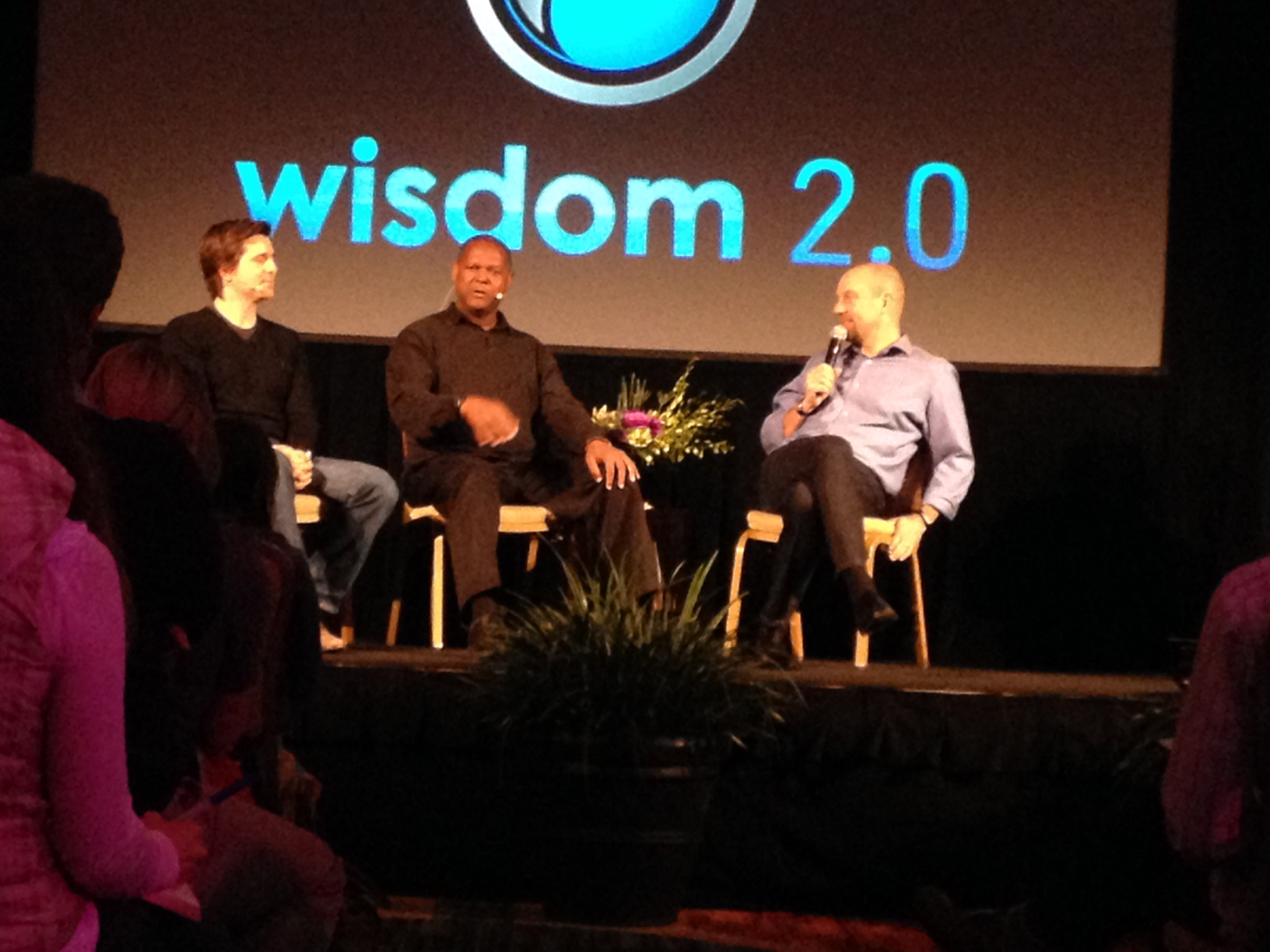
Michael Gervais, (left) George Mumford and Mike Robbins (right) discuss sports and psychology and the Wisdom 2.0 conference in San Francisco February 28, 2015,
Many of you have probably never heard of the event, so a little context is probably in order.
Attendance this year reached 2500 and could have gone higher if organizers had not capped it. The conference is designed as a combination celebration and support group for anyone trying to bring more: (pick one) consciousness, gratitude, or mindfulness to technology and business.
Attendees come from all over the world, although a large percentage are from California, to hear a variety of speakers from CEO’s to human resource managers, explain how they have tried to humanize their companies and deal with the increasing demands of the ‘always on’ world.
Using mindful meditation, exhortations to be present, and a wide variety of what many might consider alternative techniques, the conference is in direct contrast to the prevailing view of corporate America as a ruthless, cut throat, bottom line, profit driven culture.
In addition to the conference presentations on everything from neuroscience to networking, there are rooms devoted to meditation, and yoga, as well as a trade show in the Inspiration Lounge.
Many sessions focus on how to live a more fulfilling and compassionate life and to make choices that leave you happier both personally and in your career.
Here you can also find the latest in relaxation and stress reduction equipment and techniques.
While you might think the principles were some import from Europe, most of the foreign attendees, are quick to note that the techniques are uniquely American, which is what draws them here.
Companies with representative include LinkedIn, Facebook, Twitter, Google, Gap and a host of others who say that recent studies have shown conclusively that promoting mindfulness and self realization in their workforce actually adds to their bottom line in quantifiable manner.
In reality the conference is a large networking event, where like-minded folks can get together to reinforce their beliefs in hopes of connecting with someone who can help them move forward in their career.
A large percentage of the attendees are personal/executive coaches or management consultants, who are looking to make connections with those HR types from Google, Twitter, Facebook and GAP, to improve workplace performance. Admittedly the chances are slim, but you never know.
In two days I collected a raft of business cards, and spoke with lawyers, coaches, HR managers and some old friends from the spa and yoga worlds.
My wife, who is a clinical psychologist, and attended the first Wisdom conference 6 years ago, may be a more typical participant, but she was ill over the weekend and insisted I attend.
I’ll admit I was hesitant, but after three days I was pleasantly surprised and happy I made the effort. More on some of the things I learned will come in subsequent posts.
When organizers at the opening session asked who, in the audience, was a first-time attendee, I raised my hand along with two-thirds of the crowd.
Sponsors were thrilled, saying it showed how the movement was attracting new members. But you have to think; what does it mean when attendees at previous sessions are not coming back in significant numbers?
If this were a business that had to rely on new customers for 66% of it’s profit each year, would you be optimistic?

Another ‘Berkeley Moment’
February 2, 2015
Berkeley gets a bad rap from those who have never lived here, but there are some vignettes that capture its essence.
Last Saturday night, just after dark, my wife and I were walking down Vine Street after a light dinner.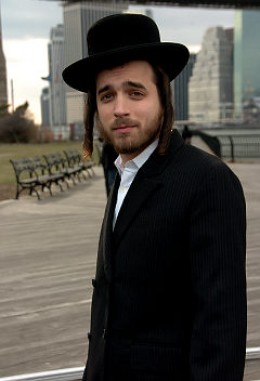
Vine Street is a main drag in the City’s ‘gourmet ghetto’ – a block from Chez Panisse, and Saul’s Deli – both icons , but on opposite ends of the foodie spectrum.
We’re just strolling along when we see a young man, obviously a Hasidic Jew, standing next to a parking meter. At the same time another man, slightly taller, but with glasses, and also wearing black hat, rekel (black coat) and payot (side curls) walks out a small door. After a quick hello, he asks me, “Are you Jewish?”
I’d never been asked quite that directly, but since it obviously wasn’t meant in any kind of derogatory fashion, I answered, “Why yes, we are. Is it that obvious?”
Without skipping a beat, the man in glasses responds, “Well, yes it is.”
It was clear that he had a sense of humor, so I asked, “Are you Jewish?”
He smiled and answered, “What gave it away, my glasses?”
Turns out he was just looking for congregants to make a minion (10 men) so they could say their prayers to end the Sabbath (Saturday evening).
But, It’s just one of those “only in Berkeley” moments, that makes the city so great.
And no, I did not join the minion, but that’s a more complicated question.
Thank You, US Postal Service
January 25, 2015
The United States Postal Service gets a lot of grief these days. Derided as the delivery agent for ‘snail mail,’ they are criticized for being too expensive, too slow, outdated and time consuming in the era of instant communication.
I am here to defend them.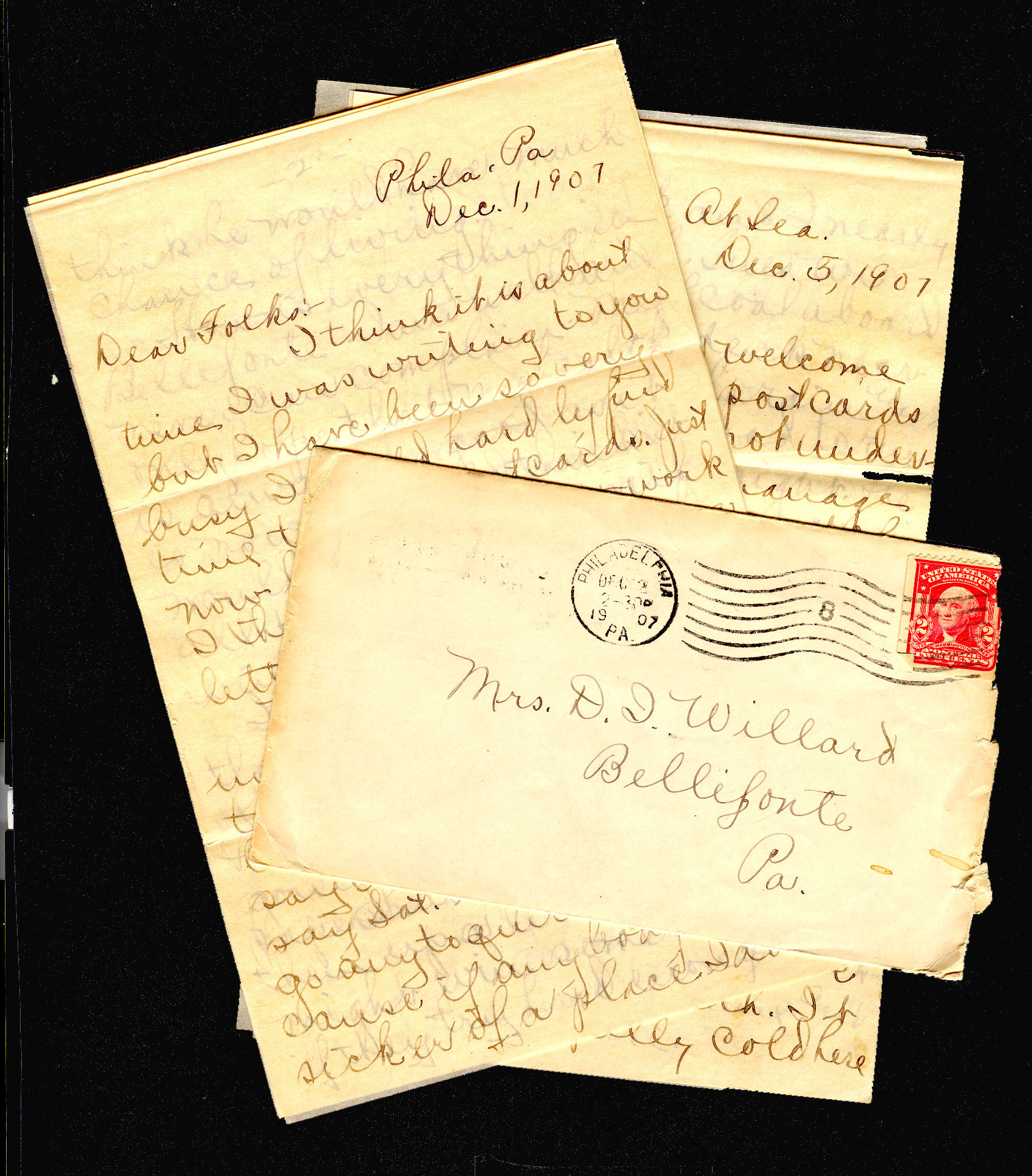
Yes, I have tracked letters sent via ‘Priority Mail’ as they traveled to San Diego before reaching their intended destination 10 days later, two zip codes from my office. I can send a package to Hawaii (from San Francisco) in two days, but the same size box to Boston takes over a week.
And yes, grandma, I remember when a first class stamp was 5 cents. I now buy forever stamps in rolls of 100, so I don’t even know what first class postage is. (Great marketing, if you ask me.)
I can text my friends all over the country and within 10 minutes will have a response…any longer and I get impatient. Email, which we all thought was great a few years ago, is now too slow, since most people still have to check before responding.
I tweet to my followers, and most of my relatives have Facebook pages,so we’ll all know who’s doing what. I write this blog so everyone knows how I feel about what’s going on in the world.
But none of those methods can generate the emotions of a stamped letter. Neuroscientists now know that memories are more than just events. Our brains recall all five senses and any of them can spark a memory.
I was reminded of that this week, when a good friend, David Allen, sent me a batch of letters, found while cleaning out his mother-in-law’s attic.
They were written over 47 years ago when I was a freshman at Bucknell University in Lewisburg, PA. In fact, they were written in the first few months of college, when I was really still attached to my high school experience and scared to death about the future.
I remember the onion paper, the smell of the inked ribbon , and the old green and white Smith Corona that I used, to peck out letters to my parents, friends and former high school classmates. I still have the typewriter in fact – even had it reconditioned after I found it while going through my old homestead when my Dad died. I’m told it’s a collector’s item.
The letters were written to David’s wife, Betty, my best friend, and while we were never involved romantically, are filled with good natured banter that would pass for flirtation.
The actual content is really irrelevant: my observations about classes, social life, campus events, and gossip. It was 1967, and I know every campus was awash in protest and politics, but there’s none of that, so I doubt Oliver Stone will need them for some new 1960’s expose.
But for me, they are more important than any email, tweet or text I will ever send. When I re-read the words, and hold the letters, the memories of those years come flooding back. More importantly, I’m talking to my friend, Betty, again, even though she was struck down by cancer 12 years ago.
So, while I can find endless versions of various web pages, and can see the trail of my texts to friends and colleagues, none of them will ever hold the power of the printed word that I can pick up, hold in my hand, and still smell the memories from so many years ago.
For that I thank the US Postal Service and David, who was thoughtful enough to mail them back to me..
Would You Reprint Charlie Hebdo’s Cartoons?
January 13, 2015
Ever since the attack on Charlie Hebdo last week I’ve been wondering what I would have done if I were still an editor at a newspaper.
The day after the attack, I was consumed with embarrassment for my profession when so few papers, who reported the murders, printed any of the offending cartoons.
As part of their coverage some publications in Europe did print a cartoon, but except for the Washington Post, I’m not aware of any major US publications who printed an example.
Even the Post printed the cartoon on the editorial page leaving the news columns free to describe the artwork. They, like the New York Times and other publications, claimed the actual drawing ‘were not relevant’ and their message could be communicated in words.
Clearly the cartoons were relevant, and just as clearly, mere words could not describe why the cartoons led to the attack. In truth, after looking at a sampling of the cartoons, I found many childish, insulting and tasteless, but I would still defend their right to publish them.
Almost every religion came under attack, but according to some, only the Muslim faith specifically prohibits depictions of their prophet.
My outrage, was tempered by a good friend, recently ‘retired’ from a small local publication, who noted that if had been editor, he’s not sure if, as a married father, he could take the risk of publication, even in a small hometown weekly.
Would the emotions of any editor be any different. Presumably they could all be the mothers or fathers of young children, and publication would open them up to the same fate as Charlie Hebdo’s cartoonists.
I guess my anger was more rooted in the excuse that the cartoons “were not relevant” to the story. I just wish the editors would admit they were scared and, while they knew that failure to publish meant the jihadists had won, they would be honest about it.
I had the same thought this week when the new cover of Charlie Hebdo was released and the announcement in my email, only showed half the drawing.
I still don’t know what I would have done, were I still the editor of a newspaper or even if I should use a cartoon to illustrate this blog post?
But I hope I would at least be honest with my readers.
Maybe, if somehow everyone published the cartoons, there would be strength in numbers like the 1 million French citizens who marched in defiant solidarity in Paris last weekend.
Salary Talk
October 9, 2014
Should you discuss salary at a job interview?
My answer is an unequivocal, “No,” although I admit sometimes it’s impossible to avoid.
A recent example from my practice explains why. My client recently graduated from college and was about to go out on his second job interview. (His first landed him a job offer that he turned down because of the location – but that’s a different post)
We were going over possible interview questions and he asked about salary. I gave him my standard answer and we talked about ways to deflect questions.
I explained that the purpose of an interview is to get an offer and once you have an offer that’s when you discuss salary and benefits.
“But what if they just ask directly, how much money I want?” he asked. I suggested he explain that he didn’t know the exact job responsibilities, so he could not estimate what the salary should be. The point is ,that if they have not published a salary range, you don’t want to ask for too little or too much. There are a host of negotiating techniques and strategies at play, but that’s it, in a nutshell.
After the interview he called to say, sure enough, they asked for a salary requirement and were insistent that he offer a number. None of my suggested answers put them off, so he gave them a number.
Guess what, three weeks later, he got a job offer and the salary was exactly number he mentioned. He asked if it would be improper to ask for more and I assured him that it certainly was not out of bounds. We discussed how he should approach the matter, given what he said at the interview and he told me later that he got a small boost, but it made him feel much better about taking the job.
If you want another real world example check out this from Maria Klawe President of Harvey Mudd College at a recent forum on women and pay. She admits that she left $50,000/year on the table because she accepted the job and then asked about salary.
My advice, whether you know the salary range in advance, or not, try not to offer an expected salary or you will always wonder if you left money on the table.
On the Road Again
September 3, 2014
My wife and I just got back from a road trip to Sun Valley, ID. For more on that, see my previous post. Among other things, we took in the annual Wagon Days celebration in Ketchum- complete with the jerk line mule team.
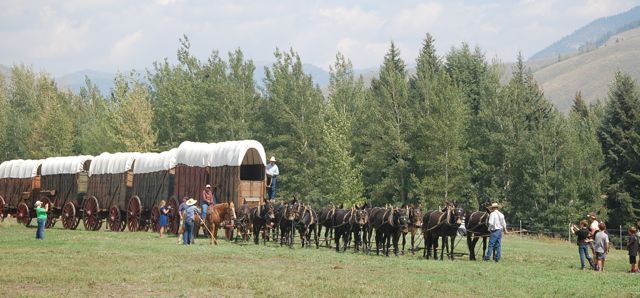
The mule team with ore wagons
This was our first drive through this part of the world and I can’t help making a number of observations.
If ever there was a place where there is no ‘there, there’ this is it. The fact that Burning Man is held 75 miles north tells you how far off the beaten path Black Rock Desert is.
The five hours from Reno to Elko has a number of exits with town names, but you couldn’t see much more than a few trailers by the side of the road.
The exception was Imlay, home of the Thunder Mountain Monument – a unique home constructed of debris from the local junkyard, and concrete.
The major industry in Northern NV appears to be power production and mining. Where else do you see road signs promoting Barrick Gold.
It was still nice to see my tax dollars at work repairing overpasses at 5,000 feet with lanes closed and minor backups. I found some of the downhill sections of the high desert a bit intimidating and I couldn’t figure out why until I noticed there were no guard rails. Nothing to keep sleepy motorists from simply driving off the road and down 1,000 foot embankments. We did see one car which did just that.
Parts of Route 80 in California are similar. I assume it’s to leave room for snow plowing, but still, it is odd.
Speaking of Route 80. Let me suggest that you don’t drive West on Labor Day. You’ll be joined by about 15,000 folks leaving Burning Man, along with the usual Labor Day traffic. Since many of these weekend Burners have never driven a trailer or camper before (much less a motor home) their skill at navigating Donner Pass was negligible. The result was a backup from Truckee to Nevada City, even though there wasn’t a serious accident in sight.
Two other stops to avoid during that period are the truck stop in Fernly, NV which must be the only gas station on the way out of Gerlach, and the new Whole Foods in Reno. Every other car we saw was covered in the signature desert dust of Black Rock and filled with hungry shoppers snapping up food for the trip home to the Bay Area.
If you ever decide to make the 11-hour drive to Sun Valley, let me add one word of caution on road signs. I have a particular pet peeve with signage that isn’t clear to someone who hasn’t driven the road before. A case in point is SR93 in Twin Falls – a lovely new bypass that takes travelers outside of the downtown area, though a number of mall zones, that US suburbs have made famous.
Problem is, unless you spot a single small sign pointing out a left turn, to continue on SR93 you will wind up far from you eventual destination. I guess the folks in Twin Falls just like to have lost motorists driving around aimlessly.
My favorite road sign of the whole trip was just outside of Elko, proudly proclaiming an exit for Beverly Hills. I’m sure Rodeo Drive was just off the exit ramp.
Sun Valley Serenade
September 2, 2014
My wife and I closed another hotel this weekend.
Well, I guess the Sun Valley Lodge was going to shut down for 9-month renovation, whether we stayed or not, but we were among the last guests to see the Lodge in its current incarnation.
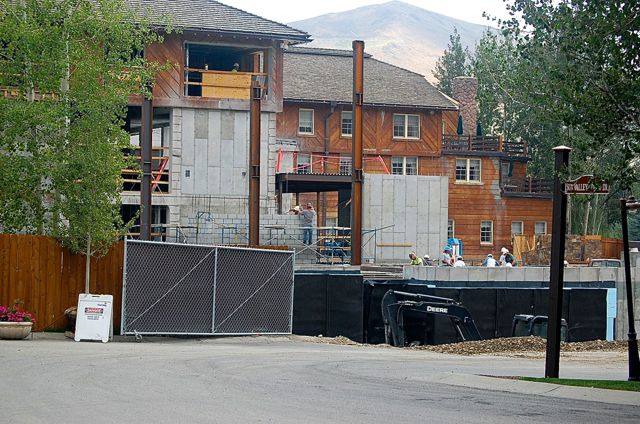
The spa and apartment units
The 124-room, 78-year old symbol of high-end fun in the snow will be converted into a 96-room playground for the rich and famous.
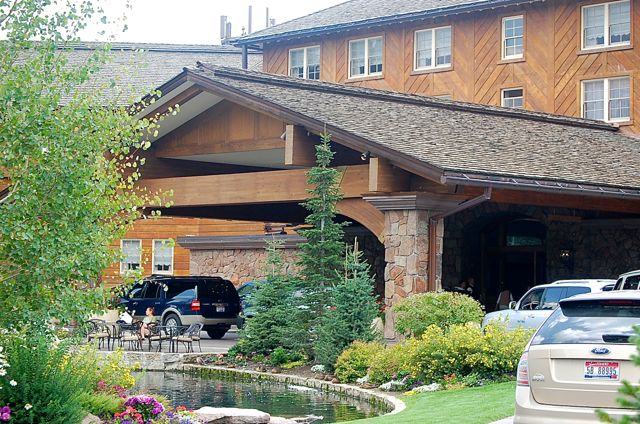
Big changes planned inside
The Lodge will renovate every room, except one, expanding them to accommodate fireplaces, and updated bathrooms which will include Jacuzzi tubs and modern amenities.
The truth is the renovation is long overdue. While the Lodge, which bills itself as America’s first destination ski resort, is the priciest in the Ketchum-Sun Valley area, it fares poorly when compared to many budget priced hotel rooms. Where rooms are larger, and bathroom space for two people often included double sinks.
The Lodge was built in 1935 by the Union Pacific Railroad and has only had three owners. It’s only relatively recently that the current owner Carol Holding, who owned Sinclair Oil with her late husband Earl, made the resort and the surrounding area into a year-round destination.
The Holdings also own a number of other five-star resort properties in the Western United States
Before Mr. Holding, began marketing the location to events such as the annual Allen and Co. technology and media conference, most of the private jets at the Blaine County airport, only came during ski season. Now it’s not unusual to see folks like Arnold Schwarzenegger, Mariel Hemmingway, or tech moguls wandering downtown Ketchum year round.
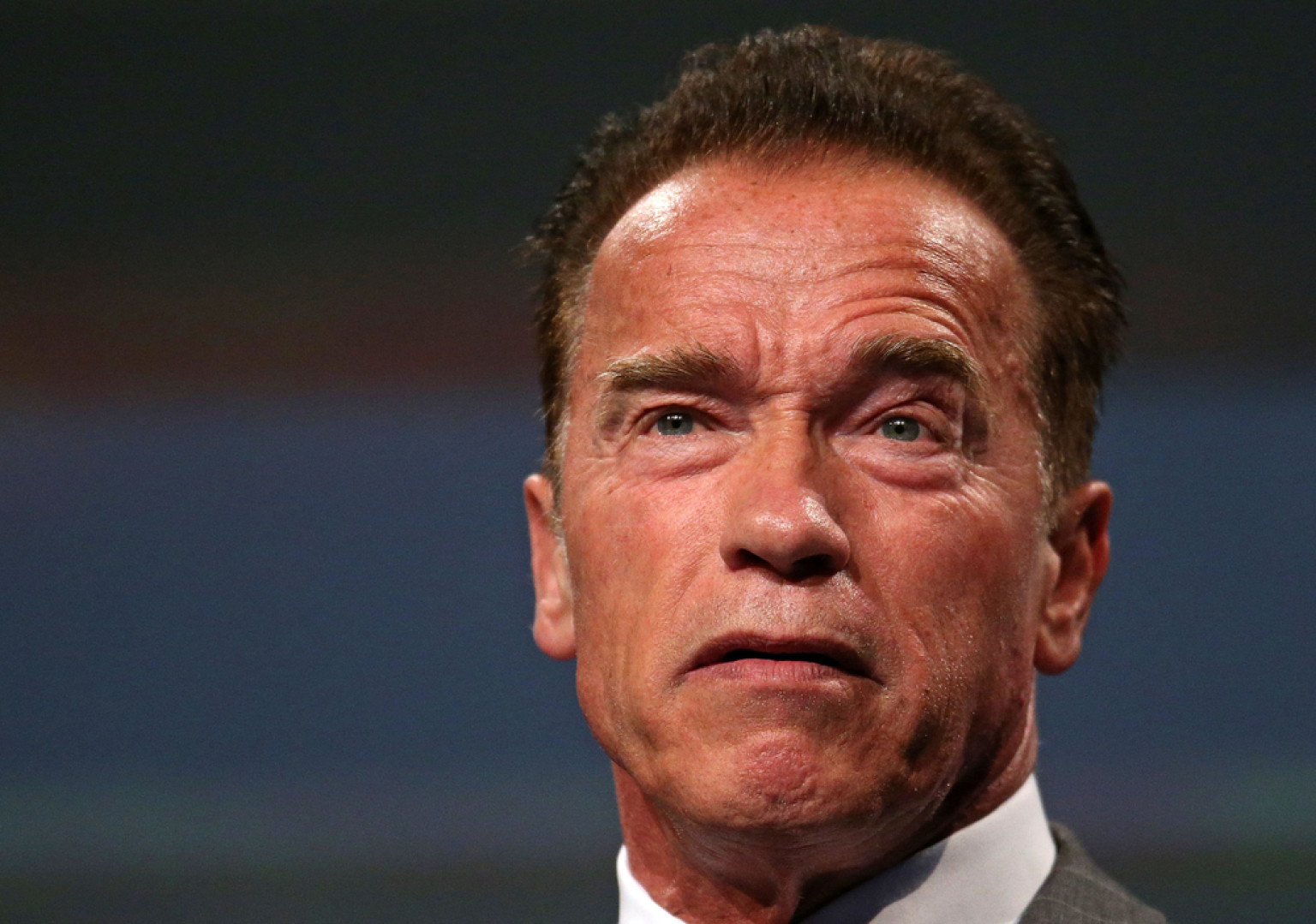
A Labor Day visitor
California’s former governor was there over the recent Labor Day weekend, with his current young honey, but that’s a story for another post.
For the last four months the Lodge has been the site of a major addition to accommodate a new spa and fitness center as well as several 4-bedroom apartment units designed for families or wedding parties.
You can find more details about the renovation at the Lodge website but you won’t be able to stay there until June of 2015 – just in time for the Allen and Company gathering.
A true sign of the year-round nature of the Lodge business, is the fact that they are closing for the what used to be high-season for The Valley ski industry.
Until next summer, you can stay at the Sun Valley Inn, the sister hotel barely 100 yards away, or at any of the many condominiums managed by the Lodge.
In general, locals are thrilled and seem genuinely happy that a new generation of the Holding family is taking an active interest in managing the mini-empire. Carol Holding, is in her 80’s, and has been largely a ceremonial leader since her husband died in 2013 but her son, Stephen, has apparently taken over and as the press release says, wants to guarantee another 75 years of ownership.
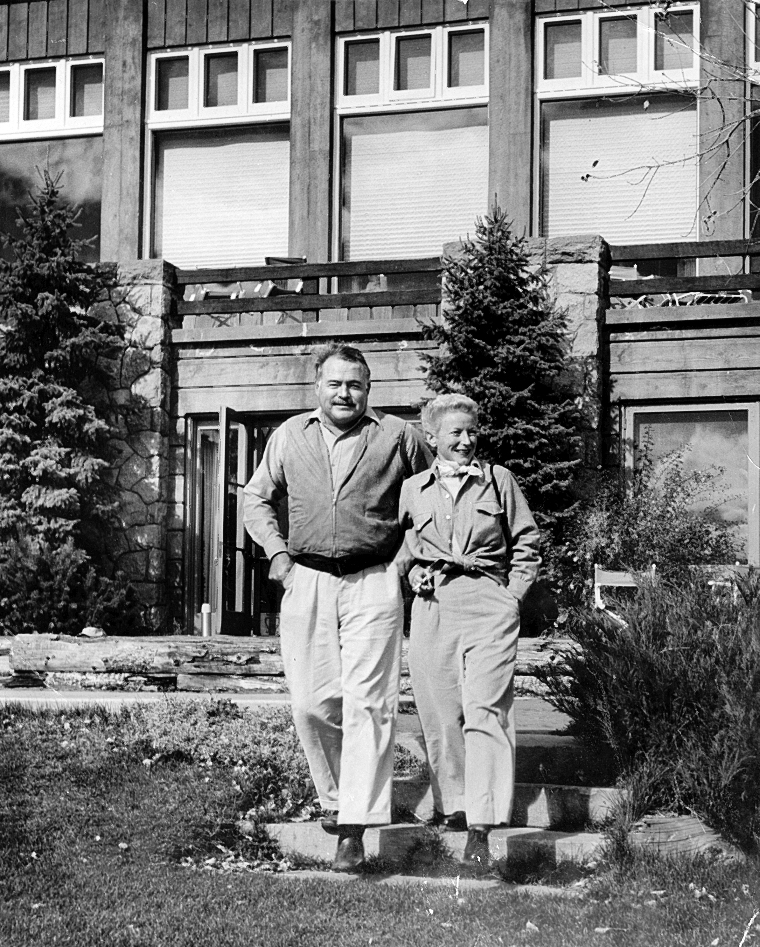
Ernest and Mary Hemingway
By the way, that lone room that will not be renovated? You guessed it – room 206, which hosted Ernest Hemingway and his lover in 1939, as ‘Papa’ finished “For Whom the Bell Tolls.” Current hotel employees say the room has never been fully renovated and includes the original claw-foot tub- and can still be rented – although the plumbing apparently clogs frequently.
But the isolated cabin, where Hemingway lived during his Sun Valley years, and where he died, is on private land and not open to the public.
If my wife and I probably win the lottery by next year- we’ll be able to afford the rates at the new Lodge, since the area is truly a beautiful destination any time of the year and we look forward to returning for the annual Sun Valley Wellness Festival next May.
What’s Wrong with Mr. Obama?
July 6, 2014
Recently Peggy Noonan at the WSJ wondered how President Obama could have failed so badly, at least according to a recent poll.
I couldn’t help wondering what was so bad about our foreign and domestic policy.
Exactly what part of our foreign policy is a disaster?
Is it Richard Sherman’s Fault?
January 30, 2014
It’s probably unfair to blame Richard Sherman for Jeannie’s death, but I do.
Sherman is the Seattle Seahawk’s player who tipped a game-winning pass away from The Forty-Niner’s Michael Crabtree in the final minute on the division championship game.
But shortly after that play, Jeannie made good on her year’s-old threat and committed suicide in a lonely extended stay motel just north of San Francisco.
As Sherman was exploding with a steroid induced rant against Crabtree, for a perceived insult months earlier, Jeannie was carrying out a plan she had conceived years earlier. After enduring more than 10 years of worsening depression, she felt she could not endure her own emotional roller coaster any longer.
A San Francisco native, and lifelong ‘Niners’ fan, she no doubt, watched the game, alone, as she arranged her jewelry, attaching notes to the new owners. She had traveled to the Bay Area from her home in Idaho, seeking yet another round of treatment for her affliction.
Maybe it’s not Sherman’s fault. We all share some blame. After all, I watched the end of the game at a friend’s home, less than 5 miles away from her, rooting against the ‘Niners’. As a California transplant, I just could not cheer for a team filled with what I considered a collection of boorish thugs. I’ll leave it to quantum physics to explain, but as the ad says, “It’s not crazy if it works.”
Perhaps, her friends and family should have tried harder to talk her out of her plan. But she made sure no one knew exactly what she was up to. In one of her manic moods, she went shopping a few days earlier, buying expensive new clothes and paying in advance for the alterations.
She kept an appointment with her doctor, listening intently as he explained his new treatment plan. From all accounts she was involved, although unquestioning in her resolve that this time it would work. After all, she had some periods of normalcy, even happiness, just a few weeks ago. We exchanged New Year’s greetings and she was absolutely ebullient that she had turned the corner and 2014 was going to be great.
But, like so many times in the past, it was a false hope, before her last fight from Idaho. She asked that we all respect her privacy as she dealt with the doctor and her inner demons, but that was pretty much the same routine as her previous visits. Hours before we received the call from her husband, still in Idaho, my wife and I had talked about Jeannie and considered, calling, texting, or emailing, deciding that like so many other times, she would let us know when she wanted companionship.
As we left out friend’s home, late Sunday night, we didn’t realize she would be ‘celebrating’ Richard Sherman’s athleticism by signing the papers leaving various body parts to science, particularly her brain, which is now slated for study at Harvard.
I hope it provides some help to another tortured soul. Maybe it will provide some clue of the lasting impact of electric shock treatment, or the permanent changes caused by continual cocktails of prescription medication, cooked up by pharmaceutical companies.
My wife is understandably devastated that her lifelong friend would not even consider some of the complementary techniques that others have found helpful. As best buddies from high school, their lives were intermingled: schools, graduations, parties, trips, vacations. Now, there is no one she can share those memories with.
I don’t know if Jeannie even bothered to take the new selection of ‘miracle drugs,’ before she packed her bags and wrote a final note with a carefully placed arrow pointing to the bathroom where loved ones could find her body.
Mr. Sherman, it’s not your fault, but I need someone to blame.
New York Commentary
September 24, 2013
I just got back from New York City , and couldn’t help making some observations:
As California contemplates naming its newest bridge after the still very alive Willie Brown, it’s worth noting that two well known bridges in New York have been unsuccessfully named after two well respected deceased politicians.
The Triborough Bridge was renamed in 2008 after Robert Kennedy and the Queensboro, or 59th Street Bridge, was renamed for former Mayor Ed Koch. Maybe it takes more than a few years, but both names are used only derisively by New Yorkers, despite numerous signs. The cabbies are particularly dismissive, noting they expect soon-to-be former Mayor Michael Bloomberg, to pay to have the Brooklyn Bridge named after himself.
Speaking of Brooklyn. You can’t help but notice how the borough has become the center of the universe to many. With Nets shirts and paraphernalia far out outnumbering Knicks jerseys, even in Manhattan. Brooklyn is the trendy place to live, work, start a new business or just hang out. But more than one New Yorker pointed out how difficult it is to drive anywhere in Brooklyn and a few noted that it still has a lot of rough edges with graffiti decorating many buildings, and toni new restaurants in neighborhoods where you really would not want to walk at night. Maybe they’re just jealous…who knows?
We took a walk along the High Line – the west side railway converted to a pedestrian walkway. The best part of the walk is the section that crosses 10th Avenue, which includes stadium seating behind a row of huge windows. It’s like watching a series of big-screen televisions, all playing reality TV, New York style. A favorite place for natives to enjoy lunch.
You can’t help but notice the increase in bikes in New York City. The Citi Bikes program which allows anyone who signs up, to take a bike from one stand and return it to another, seems to be a hit with New Yorkers. We did witness a number of near-injury accidents with pedestrians and cars. It just adds to the element of surprise in navigating the New York streets. Drivers seem to universally hate the new vehicles, I guess until they get out of their car and on to a bike. A similar program is just getting under way in San Francisco.
We had a very nice chat with a cab driver from Senegal, explaining to him the difference between being a cabbie in NYC and SF. A few hills but fewer cabs: pedestrians who walk first and expect you to stop: drivers who are relatively polite: fewer people; smaller city; and a host of other factors. He added that driving inn New York can be stressful but it’s just part of the job.
Cabbies here are like waitresses in LA. They are all on their way to something else. Our driver from Senegal was just waiting to start his own business (undetermined) and a second cabbie was going to community college to get an AA so he could become a police officer, like his sister. They actually give policemen a small replica badge (3 each) to give to family members that says “brother of policeman” or whatever is appropriate. He says it helps with minor infractions, but does nothing if you’re caught speeding. My brother-in-law is a SF cop, we got nada. (Will have to check on it)
Genetically Modified food doesn’t seem to be a big issue in New York. Maybe it’s just because we had an initiative that failed in California, or maybe it’s just my wife who won’t eat GMO food, but no one seems to even notice GMO’s. Even a restaurant specializing in healthy , nutrient rich food, made no mention of GMO’s on the menu, and our waiter, seemed puzzled when we asked.
Finally, no trip would be complete without some comments on flying. Yes, we continue to use United Airlines, hoping against hope that we’ll score a free upgrade, based on my lifetime miles. We returned to SF on a reconfigured 757, which included wifi. I never used it before so for $10 I gave it a try. Worked pretty well, although there’s a bit of a delay in response time for web pages. Plus, I only bought an hour and lost part of my time when we crossed a time zone and my clock updated automatically.
While the flights went well, despite two lousy movies, the trip ended on a sour note, as our luggage took almost an hour to get delivered to the baggage claim area. I wouldn’t mention it except that it happens every time we travel. Retrieving baggage at SFO always takes longer than any other airport. No -one seems to be able to explain why, but it’s been consistent for the 20 years I’ve been traveling out of SFO.
As United Airlines begins a new PR campaign to convince us that it really cares about it’s customers, I wish they would fix the parts that matter to its customers.